Allowable expenses self employed: what you can claim

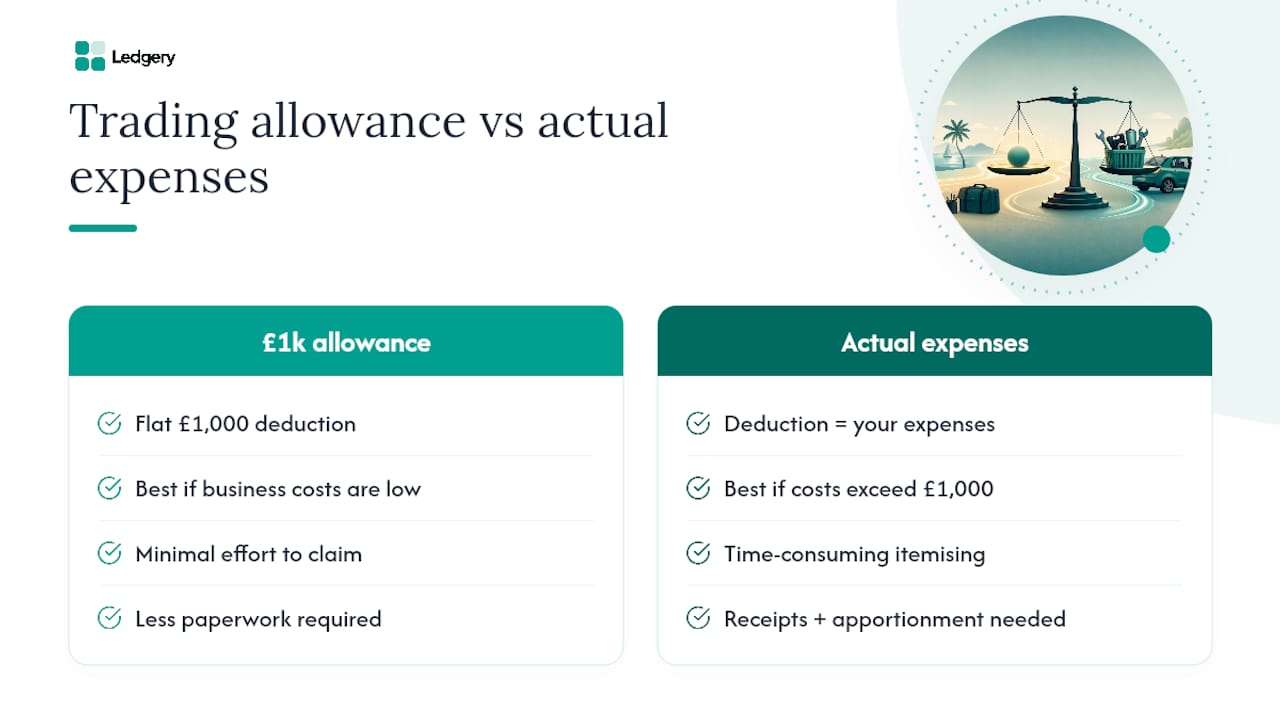
You can deduct allowable expenses from your income to reduce your taxable profit, provided each cost is incurred wholly and exclusively for your trade. That single test, set out in HS222, decides whether HMRC will accept a claim. If your total business costs are low, a trading allowance may work better than adding up actual expenses.
Before you file anything, sort out these basics:
- Decide whether the trading allowance or actual expenses gives you the better result
- Keep or digitise every receipt, invoice, and bank statement
- Record the business proportion of any mixed-use item, such as a phone or a home office
- Check whether simplified expenses or Making Tax Digital software, such as Ledgery, suits your workflow
Pro Tip: If your allowable costs sit close to £1,000, calculate both methods before you submit. The trading allowance is quick, but it blocks you from claiming anything else that year.
Key Takeaways
Allowable expenses reduce taxable profit only when they meet HMRC’s wholly and exclusively test, and choosing between the trading allowance and actual costs is the first decision that shapes everything else.
| Point | Details |
|---|---|
| Apply the wholly and exclusively test | Only costs genuinely tied to your trade qualify; apportion anything with personal use. |
| Compare trading allowance vs actual expenses | The £1,000 allowance suits low-cost businesses; higher spenders usually gain more from itemising. |
| Separate capital from revenue items | Equipment and vehicles often need capital allowances rather than a straight expense deduction. |
| Use simplified expenses selectively | Flat rates save admin but can underclaim for heavy home or vehicle use. |
| Keep evidence for five years | Retain receipts and logs for several years after the filing deadline to survive HMRC checks. |
Table of Contents
- What counts as an allowable expense self employed can claim?
- Common categories of allowable business expenses UK sole traders use
- Are capital allowances different from revenue expenses?
- Should you use simplified expenses or cash basis accounting?
- How do you apportion working from home costs?
- What mileage rate can you claim for business travel?
- Record keeping, HMRC checks and common mistakes
- Three worked examples of allowable expense treatment
- Reduce filing stress with Ledgery
- Allowable expenses for self-employed: what actually matters
- Sources
What counts as an allowable expense self employed can claim?
HMRC’s “wholly and exclusively” rule, detailed in the HS222 helpsheet, means a cost must exist purely because of your trade. If there’s a personal benefit tangled in with the business one, only the business portion counts.
Mixed-use costs need apportioning, and HMRC accepts several practical methods.
- Time-based splits, for a laptop used partly for admin and partly for streaming
- Room-based splits, for a home office measured against total floor space
- Mileage logs, for a car used for both client visits and the school run
A phone bill might be 60% business calls, 40% personal chatter, so you claim 60%. Broadband often gets split by hours used for work each week. Clothing rarely qualifies unless it’s genuine protective gear or a uniform, since HMRC treats everyday clothes as dual-purpose by nature even if you only wear that suit to meetings.
Common categories of allowable business expenses UK sole traders use
Most claims fall into a handful of predictable buckets. Mapping your receipts to these categories speeds up quarterly reporting and reduces the chance of missing something you’re entitled to.
- Office and equipment — stationery, software subscriptions, a replacement keyboard
- Travel and vehicle costs — fuel, parking, train fares to client meetings
- Marketing — website hosting, business cards, paid social adverts
- Professional fees — accountancy costs, legal advice tied to the business, indemnity insurance
- Premises costs — rent, business rates, utilities for a workshop or studio
- Stock and materials — raw goods bought for resale or manufacture
- Insurance — public liability, professional indemnity, equipment cover
- Bank charges — fees on a business account or card payment processing
Some costs get disallowed however business-adjacent they feel. Client entertainment, gifts above small trivial amounts, fines and penalties, and your ordinary commute from home to a regular workplace all fail the wholly and exclusively test outlined in HS222. If you’re VAT registered, record the net amount of each expense, since the VAT itself gets reclaimed separately through your VAT return.
Are capital allowances different from revenue expenses?
Revenue expenses are day-to-day running costs, things you’d repurchase regularly, like stationery or fuel. Capital items are assets that last, such as a laptop, a van, or specialist machinery, and these usually sit outside the normal expenses list.
Under traditional accounting, you claim capital items through capital allowances rather than as a straight deduction, spreading or front-loading relief depending on the allowance type. Under the cash basis, most equipment purchases (except cars) are simply treated as allowable expenses in the year you pay for them, which HS222 confirms.
- Cars are excluded from that cash basis simplification and follow separate capital allowance rules regardless of accounting method
- Depreciation itself is never an allowable expense under either system
- Capital allowance claims go in the specific capital allowances section of your Self Assessment return, not mixed in with general expenses
Timing matters here: claim a large capital allowance in a low-profit year and you may waste part of the relief, so plan purchases against your expected income where you can.
Should you use simplified expenses or cash basis accounting?
Simplified expenses let you use flat rates instead of calculating actual costs, mainly for vehicles and working from home, and HMRC’s guidance confirms they’re designed purely to cut admin, not to guarantee the biggest deduction.
The cash basis records income and expenses when money actually moves, rather than when invoiced, and it’s available to most sole traders. Under cash basis, equipment purchases (bar cars) get treated as expenses immediately.
Work through this checklist each year:
- If your receipts are patchy and your time is tight, simplified expenses save hassle
- If your actual home or vehicle costs are high relative to the flat rate, calculate real figures instead
- If you’re unsure, run both methods once and compare, since switching later is allowed but rarely worth the retrospective admin
Pro Tip: Simplified expenses feel effortless, but they can undercharge you if you’ve got a genuinely large home office or a fuel-hungry vehicle. Check the numbers before defaulting to the flat rate every year.
How do you apportion working from home costs?
Two methods dominate: a room-based split, where you divide total household bills by the proportion of rooms used for work, and a time-based split, where you calculate hours worked at home against total hours in a week.
Say your home has five rooms and you use one exclusively as an office 40% of your working week. A room-based split alone might overstate the claim, so many self-employed people blend both: apply the room fraction, then adjust for time actually spent there.
| Method | How it works | Best suited to |
|---|---|---|
| Simplified flat rate | Fixed monthly amount based on hours worked at home | Low admin, occasional home working |
| Room and time apportionment | Calculate business share of actual household bills | Regular, heavy home-based work |
Phone and internet costs are calculated separately from the general household apportionment, since HMRC treats them as their own line item. Simplified flat rates suit people whose home-working pattern is light or inconsistent month to month.
What mileage rate can you claim for business travel?
HMRC’s approved mileage rate is 45p per mile for the first 10,000 business miles in a tax year, dropping to 25p per mile after that, and it applies to cars and vans used for genuine business journeys, as confirmed on the SA103F self-employment form guidance.
You choose between this flat mileage rate and claiming actual costs (fuel, insurance, servicing, finance) apportioned for business use, but you can’t switch methods for the same vehicle partway through owning it.
- Ordinary commuting from home to a regular workplace is never allowable
- Overnight subsistence on a genuine business trip usually is, within reasonable limits
- Keep a mileage log noting date, purpose, and distance for every claimed journey
Mixing the two approaches on one vehicle invites exactly the kind of inconsistency HMRC flags during checks.
Record keeping, HMRC checks and common mistakes
Keep receipts, invoices, bank statements, and mileage logs for five years after the 31 January submission deadline, a retention period confirmed by HMRC’s trading allowance guidance. Digital copies count, provided they’re legible and complete.
HMRC’s compliance checks guidance states that weak apportionment and thin evidence are common triggers for enquiries. Avoid these mistakes:
- Guessing a business-use percentage instead of calculating it from a log or bill
- Claiming personal costs alongside genuine business ones without separating them
- Losing receipts because they were paper-only and faded or misplaced
Digitising receipts at the point of purchase, rather than reconstructing months later, is one of the simplest ways to survive a compliance check without stress.
Ledgery lets you photograph receipts as they arrive and organises them into the quarterly summaries MTD will require, with deadline alerts built in so nothing slips.
Three worked examples of allowable expense treatment
- Home office: One room out of five, used 50% of the working week. Apportion the room fraction first, then reduce by the time factor, rather than claiming the full room cost.
- Phone bill: A £40 monthly bill with a two-week call log showing 65% business calls. Claim £26 a month, and keep that log as evidence if asked.
- Mileage: 8,000 business miles logged in a year. At 45p per mile, that’s a straightforward flat-rate claim with no need to total fuel receipts separately.
Correct invoicing also strengthens your record trail. TradeSmith’s guide to UK invoice requirements sets out exactly what a compliant invoice must show, which matters if HMRC ever asks you to evidence income alongside expenses.
Reduce filing stress with Ledgery
Working out allowable expenses is only half the job. The other half is proving them if HMRC asks, and that’s where most self-employed people lose time. Ledgery scans receipts as you receive them, sorts them into categories that map to HMRC’s own expense groups, and builds the quarterly updates that Making Tax Digital will require. If you earn over £50,000, that quarterly rhythm becomes mandatory rather than optional, and getting comfortable with it now avoids a scramble later. Ledgery’s free first quarter lets you test the receipt scanning and reporting workflow before committing to a paid subscription, with deadline alerts so you’re never caught filing at the last minute.

Allowable expenses for self-employed: what actually matters
The conventional advice on this topic spends too much time listing categories and too little time on the one decision that actually changes your tax bill: trading allowance or actual expenses. Most guides treat that choice as a footnote. It shouldn’t be. Get it wrong and you either leave money on the table or waste hours itemising costs that never beat the flat £1,000.
What’s genuinely underrated is how much the record-keeping habit matters more than the rule itself. HMRC rarely disputes a correctly categorised expense. It disputes claims with no evidence behind them, which is why the compliance checks guidance keeps circling back to weak apportionment as the common failure point.
Prioritise the habit before the optimisation. Photograph receipts the day you get them, log mileage as you drive, and revisit your method choice every year rather than assuming last year’s answer still fits. A digital workflow, whether that’s a simple spreadsheet or a scanning tool such as Ledgery, does more for your tax position than memorising every line of HS222 ever will.
Recommended
Self-employment and property income in one subscription, first quarter free. Join the early access list and we’ll email you once, when it opens.
Join early access