Balancing payment self assessment: what you need to know

A balancing payment is the final amount of tax you owe for a tax year after all payments already made have been deducted. The official formula, set out in HMRC’s Self Assessment legal framework, is straightforward: balancing payment = total tax liability − (payments on account + tax deducted at source/PAYE). If the result is positive, you owe HMRC money. Otherwise, HMRC may owe you a refund.
Three things to confirm before the deadline:
- Check your Self Assessment tax calculation in your HMRC online account for the exact figure.
- Use the correct 11-character payment reference (your 10-digit UTR followed by the letter ‘K’).
- Pay early enough for the payment to arrive by midnight on 31 January.
Key takeaways
A balancing payment is the final tax owed after all payments on account and deductions have been subtracted, and it is due by midnight on 31 January following the end of the tax year.
| Point | Details |
|---|---|
| Know the formula | Balancing payment = total tax liability minus payments on account and tax deducted at source. |
| Confirm your reference | Use your 10-digit UTR plus the letter ‘K’ as the 11-character payment reference on every payment. |
| Plan for processing time | Faster Payments arrives same or next day; Bacs takes 3 working days; allow more time for cheques. |
| Contact HMRC early if needed | A Time to Pay agreement or Budget Payment Plan reduces penalties; do not wait until after the deadline. |
| Use Ledgery for year-round visibility | Ledgery’s quarterly summaries and deadline alerts help you estimate and prepare for balancing payments in advance. |
Table of Contents
- How is a balancing payment calculated?
- When is a balancing payment due?
- Where do you find the exact amount you owe?
- How to pay your balancing payment
- What to do if you cannot pay by the deadline
- Pre-payment checklist
- How Ledgery helps you avoid balancing payment surprises
- An honest view on managing balancing payments
- Ledgery keeps your Self Assessment on track
- Sources
How is a balancing payment calculated?
The total tax liability covers income tax, Class 2 and Class 4 National Insurance Contributions, and student loan repayments where applicable. From that total, HMRC subtracts any payments on account you have already made and any tax deducted at source through PAYE.
What counts in each component:
- Total tax liability: income tax on all sources, Class 2 NICs (flat rate), Class 4 NICs (profit-based), and student loan repayments.
- Payments on account: two advance payments made on 31 January and 31 July during the tax year, each equal to half your previous year’s liability.
- Tax deducted at source: PAYE deductions from employment income, bank interest withheld, or other withholding already applied.
Worked example:
In this example, the two payments on account and the PAYE deduction together cover £3,200, leaving a £1,000 balancing payment due on 31 January.
When is a balancing payment due?
The primary deadline is midnight on 31 January following the end of the tax year. For the 2024/25 tax year, the balancing payment is due by the following 31 January deadline. As GOV.UK explains, this date often requires a composite payment: the balancing payment for the year just ended plus the first payment on account for the new year, both due on the same day.
LITRG highlights that 31 January can be a heavy cashflow day for exactly this reason. Many self-employed people are surprised by the combined total.
Key deadline rules:
| Situation | Deadline |
|---|---|
| Standard balancing payment | 31 January after the tax year ends |
| First payment on account (new year) | 31 January (same day, composite) |
| Second payment on account | 31 July |
| Late notice to file (issued after 31 October) | Three months from the date of the notice |
If HMRC issues a notice to file after 31 October, the standard 31 January deadline may not apply. The due date shifts to three months from the date of that notice, so check the notice itself for the correct date.
Where do you find the exact amount you owe?
The most reliable source is your Self Assessment statement in your HMRC online account. It shows your total liability, payments on account already credited, any PAYE deductions, and the remaining balancing payment. Payments you have already made appear marked ‘CR’ (credit). Any outstanding amounts from earlier years also appear here, so check the full statement rather than just the most recent entry.
If you file late and have not yet received a statement, use the tax calculation from your return to work out the figure yourself, applying the formula above.
Sources for your balancing payment figure:
- Your HMRC online account (Self Assessment section).
- The paper or digital statement HMRC sends after you file.
- The tax calculation within your completed Self Assessment return.
Payment reference requirement: every payment must carry your UTR + ‘K’ as the reference. Your Unique Taxpayer Reference is 10 digits; adding ‘K’ makes an 11-character reference. Using the wrong reference risks the payment being misapplied and treated as late.
Pro Tip: Before paying, open your Self Assessment statement and scan for any ‘CR’ entries and any amounts from prior years. Your payment should cover the net balance, not just the current year’s figure.
How to pay your balancing payment
HMRC accepts several payment methods. Processing times vary, so the method you choose determines how early you need to act.
| Payment method | Typical processing time |
|---|---|
| Faster Payments (online/telephone banking) | Same day or next day |
| CHAPS | Same working day (if sent within bank cut-off times) |
| Bacs | 3 working days |
| Direct Debit (Budget Payment Plan) | Up to 5 working days if not previously set up |
| Debit or corporate credit card | Same or next day |
| Cheque with payslip | Allow several working days for post and processing |
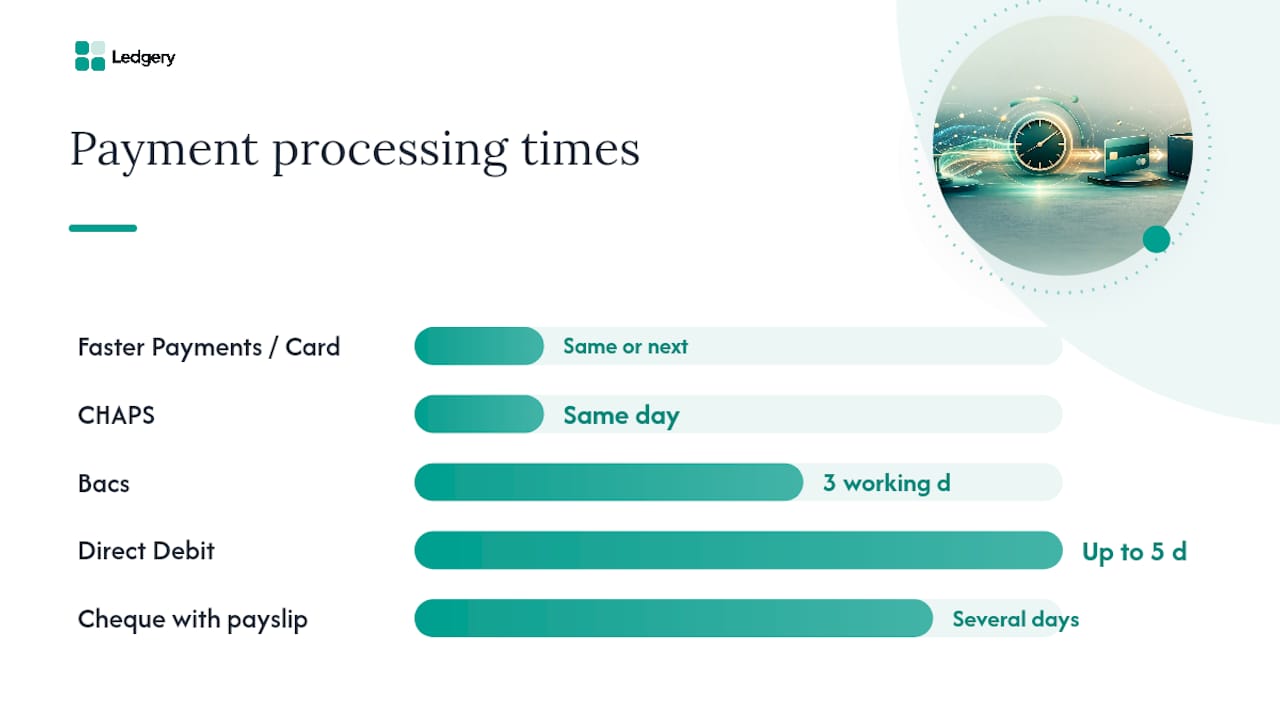
Processing times come from GOV.UK’s bank transfer guidance. Weekends and bank holidays do not count as working days, so a payment sent on Friday via Bacs may not arrive until Wednesday.
Practical points on payment:
- Always use your UTR + ‘K’ as the payment reference, regardless of method.
- If you need to make a composite CHAPS payment covering both the balancing payment and a payment on account, confirm the combined total from your statement first.
- If you do not have a payslip, you can print one via HMRC’s Self Assessment payment enquiries page or pay directly through HMRC online services or the official HMRC app.
- HMRC’s online services and the HMRC app are generally the quickest routes for most taxpayers.
What to do if you cannot pay by the deadline
Contact HMRC before the deadline, not after. Proactive contact gives you access to two main options.
- Time to Pay agreement: a negotiated instalment plan with HMRC. You contact HMRC directly to arrange it. Interest still accrues on the outstanding amount, but a formal agreement prevents the automatic late-payment penalty tiers from applying.
- Budget Payment Plan: a Direct Debit arrangement that lets you pay weekly or monthly in advance. You must be up to date with all previous tax liabilities to set one up. It is an underused option that smooths cashflow across the year and reduces the risk of a large January bill.
- Collection through your PAYE tax code: available only if you owe less than £3,000 and meet strict eligibility criteria. It is not an automatic fallback. Relying on it without confirming eligibility risks unexpected deductions from your salary or pension.
Late-payment penalties apply in tiers. A 5% surcharge is added at 30 days overdue, a further 5% at 6 months, and another 5% at 12 months. Daily interest also runs from the day after the deadline. The longer a payment remains outstanding, the more it costs. Contacting HMRC early is the single most effective way to limit the damage.
Pre-payment checklist
Before making any payment, confirm you have the following:
- Your 11-character payment reference (10-digit UTR + the letter ‘K’).
- The correct HMRC bank account details, taken directly from your bill or the GOV.UK payment page.
- The exact amount from your Self Assessment statement or tax calculation.
- A record of previous payments on account, to verify the net balance is correct.
- Your chosen payment method and a clear plan for timing, accounting for processing days and any weekends or bank holidays before the deadline.
Double-check the payment reference and destination account before confirming. A misapplied payment can take time to trace and correct, and HMRC may treat it as late in the interim.
How Ledgery helps you avoid balancing payment surprises
Missed or miscalculated balancing payments usually come down to one thing: poor visibility of income and expenses across the year. Ledgery addresses this directly.
- Receipt scanning and automatic categorisation: snap a photo of a receipt and Ledgery logs it against the correct income or expense category, keeping your records current throughout the year.
- Quarterly summaries: Ledgery produces clear quarterly reports aligned to Self Assessment periods, so you can see your likely tax position well before January rather than discovering it at the deadline.
- Deadline alerts: built-in reminders flag the 31 January and 31 July payment dates, reducing the risk of a missed payment.
- Export for HMRC submissions: records can be exported in a format ready for your Self Assessment return, cutting the time spent pulling figures together.
A self-employed consultant using Ledgery’s quarterly reports in October, for example, would already have a working estimate of their January balancing payment, giving them time to set funds aside or arrange a Budget Payment Plan if needed.
An honest view on managing balancing payments
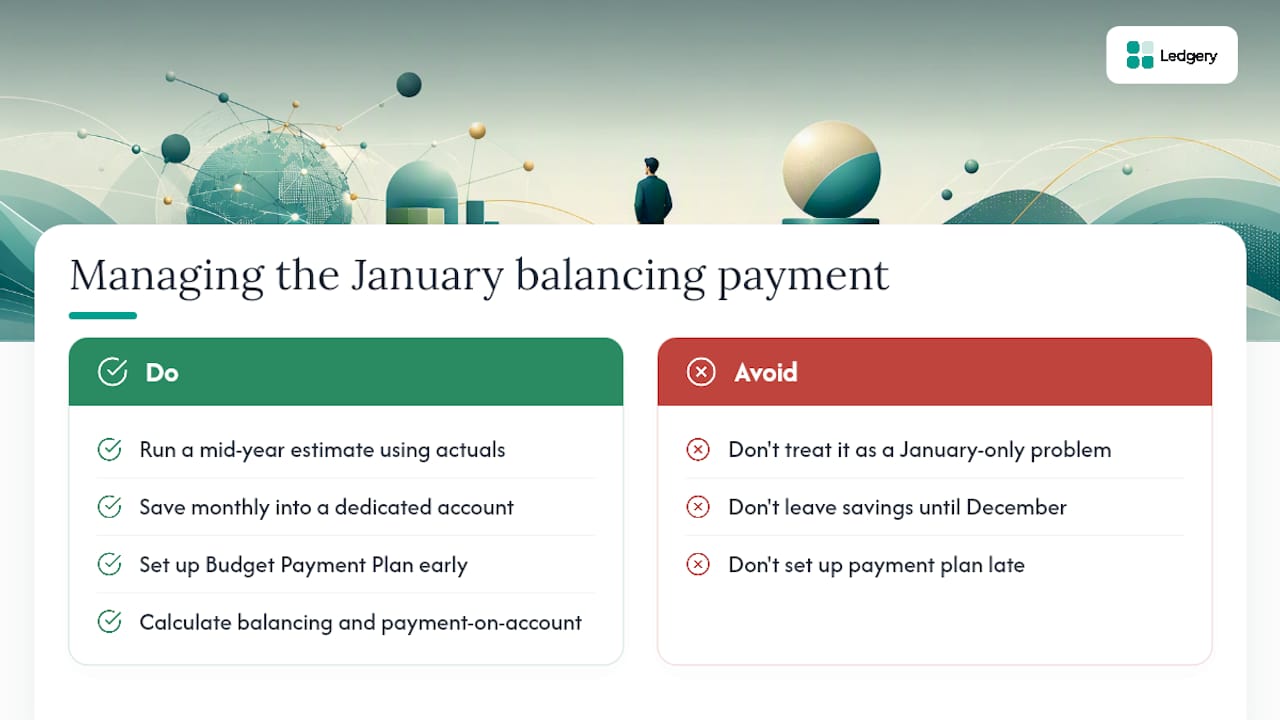
The most common mistake is treating the balancing payment as a January problem. By the time January arrives, the liability is already fixed. The only variable is whether you have the cash ready.
Running a mid-year estimate in September or October, using your actual income and expenses to date, gives you a realistic figure to plan around. Pair that with a dedicated savings account where you set aside a percentage of income each month, and the January payment becomes predictable rather than alarming. For those with variable income, a Budget Payment Plan via Direct Debit is worth setting up early in the tax year, not as a last resort.
The composite nature of the 31 January payment catches many people out. It is not just the balancing payment for the year just ended; it may also include the first payment on account for the new year. Running the numbers on both figures in advance is the clearest way to avoid a cashflow shock.
Ledgery keeps your Self Assessment on track
Calculating and paying a balancing payment correctly takes accurate records, the right reference, and enough lead time to choose a payment method that arrives on time.
Ledgery gives self-employed individuals and property owners a cleaner way to stay on top of all of this. Automated receipt scanning, quarterly income summaries, and built-in deadline alerts mean you know your likely tax position months before January, not days before. The free first-quarter trial means you can see how it works before committing to a subscription. Start your free quarter at Ledgery and go into the next Self Assessment deadline with a clear picture of what you owe.
Sources
This article is general information, not a substitute for advice from a qualified financial advisor. Consult a qualified financial professional about your own circumstances before acting on anything here.
Recommended
Self-employment and property income in one subscription, first quarter free. Join the early access list and we’ll email you once, when it opens.
Join early access