Beat the 31 January shock: HMRC payments on account UK self employed

If your last Self Assessment tax bill was over £1,000 and less than 80% of it was collected at source, HMRC will ask you to pay in advance for the current year through two payments on account. Each instalment is 50% of last year’s tax and Class 4 National Insurance, due 31 January and 31 July, with a balancing payment following the next 31 January. Check your exact figures in your HMRC online personal tax account.
TL;DR:
- Payments on account are triggered only if your previous year’s tax liability exceeded £1,000 and less than 80% was collected at source, excluding capital gains and student loans.
- The relevant amount used for calculation excludes capital gains and UK student loan repayments, based on your net tax owed after adjustments.
- Missing deadlines can lead to immediate interest charges and escalating penalties, particularly if payments are late or underestimated; early planning can mitigate these costs.
- Reducing payments on account is possible with forecasts, but HMRC may query negligent or fraudulent claims, and maintaining detailed records is essential for defenses.
- Filing your tax return early provides better forecasting opportunities, minimizes surprises at the January deadline, and allows time to adjust payments or claim reductions proactively.
Table of Contents
- Who must make payments on account
- How HMRC calculates payments on account (clear rules and worked examples)
- Deadlines and how to pay: methods and how payments appear on your HMRC account
- How to reduce or cancel payments on account: the formal routes and the risks
- Practical cashflow planning and a short checklist
- Consequences of underpayment or late payment
- What to do about disputes or queries over payment amounts
- Impact on the self-assessment filing process
- The Ledgery view on avoiding payments on account surprises
- Try Ledgery to reduce surprises: free first quarter
- Sources
Who must make payments on account
The rule is precise, not a guideline. Payments on account apply when your previous year’s relevant Self Assessment tax liability exceeded £1,000, and less than 80% of that liability was collected at source. Both conditions have to be true. If your bill was below the minimum threshold, you’re exempt regardless of how it was paid. If your bill was £3,000 but 85% came through PAYE, you’re also exempt.
“Collected at source” mostly means tax taken through your PAYE code, typically because you have employment income alongside self-employment, or because HMRC adjusted your tax code to recover an earlier underpayment. It does not include tax you paid voluntarily by cheque or bank transfer.
Some liabilities never enter the payments on account calculation at all:
- Capital gains tax, even if it forms part of the same Self Assessment bill
- Student loan repayments collected through Self Assessment
- Class 2 National Insurance contributions
Three situations trip people up regularly. People with both a job and a side business sometimes assume PAYE covers everything, when in fact only the employment slice does.
How HMRC calculates payments on account (clear rules and worked examples)
HMRC bases each instalment on your “relevant amount”: the total income tax and Class 4 National Insurance you owed for the previous year, once outside-scope items are stripped out. Each payment on account equals 50% of that relevant amount. Capital gains and student loan repayments are excluded from the calculation, so a large one-off gain won’t inflate your instalments the following year.
Two examples show why this catches people off guard.
- First year requiring PoA. Say your 2025/26 tax bill is a certain amount. By 31 January 2027, you owe that balancing payment plus a first payment on account for 2026/27, a significant total amount. That’s a 1.5× cashflow hit landing on a single date, which is precisely why new sole traders often describe January as the month that breaks their budget.
- Mixed PAYE and self-employed income. Suppose your total liability was £2,500, but your PAYE job collected £2,100 of it through your tax code, 84% of the total. Because that clears the 80% threshold, HMRC won’t set up payments on account at all, even though the £2,500 figure alone would normally trigger them.
Pro Tip: *Run your own relevant amount calculation as soon as your accounts are finalised.
Deadlines and how to pay: methods and how payments appear on your HMRC account
Three dates matter every tax year. Miss one and interest starts accruing immediately.
- 31 January: your balancing payment for the previous tax year, plus your first payment on account for the current year
- 31 July: your second payment on account for the current year
- The following 31 January: the balancing payment that reconciles what you actually owed against what your two instalments covered
HMRC accepts several payment methods, and posting times vary enough to matter if you’re paying close to a deadline. Direct Debit needs setting up several working days in advance and won’t help you if you’re paying at the last minute. Faster Payments through online or telephone banking usually clear the same or next day. Debit and credit card payments through the HMRC app or website tend to show almost instantly. Standard bank transfers (CHAPS or BACS) can take up to three working days.
Your Self Assessment statement of account, inside your HMRC personal tax account, shows both instalments and any balancing figure. If a payment you’ve made doesn’t appear within a few working days of the method’s normal posting time, contact HMRC directly rather than assuming it’s lost in the system.
How to reduce or cancel payments on account: the formal routes and the risks
If you expect this year’s profits to fall below last year’s, you don’t have to pay on the old figure. You can claim a reduction through your HMRC online account, or by post using form SA303. Both routes let you set a new, lower figure based on your own forecast of the current year’s liability.
A few practical points to know before you file the claim:
- You can reduce a payment on account any time before it becomes due, and you can amend it again later if your forecast changes.
- HMRC’s internal guidance, referenced in manuals SAM1010 and SALF303, sets out how officers assess these claims and what counts as the relevant amount.
- If your forecast turns out too low, HMRC charges interest on the shortfall from the original due date, not from when you eventually pay.
Reducing payments on account is a legitimate cashflow tool, but it isn’t a guess. HMRC can and does query claims that look negligent, and in serious cases can apply penalties where a reduction was made fraudulently.
Pro Tip: Keep a written note of how you arrived at your reduced figure, including the income estimate and the date you made the claim. If HMRC asks questions eighteen months later, that record is what protects you.
Practical cashflow planning and a short checklist
The 31 January squeeze is predictable, which means it’s avoidable. Options worth considering include paying in smaller amounts throughout the year rather than in one lump sum, setting up a Direct Debit so you’re not relying on memory, arranging a Time to Pay agreement if a lump payment genuinely isn’t feasible, and forecasting your liability early using quarterly income summaries rather than waiting for year end. Pension contributions can also lower your adjusted net income, which in turn reduces the tax on which future instalments are based.
Before your return is due, run through this:
- Estimate your full-year income and expenses, not just what’s banked so far.
- Add back any PAYE tax already collected at source.
- Decide whether a reduction claim is justified, and if so, document the reasoning.
- Flag the date to your accountant, or into your own calendar, well before 31 January.
Pro Tip: If your forecast keeps changing month to month, that’s usually a sign your record keeping needs tightening, not that HMRC’s rules are unclear.
Consequences of underpayment or late payment
Interest is the first and most automatic consequence. HMRC charges interest on any unpaid tax from the day after the due date, whether that unpaid amount is a payment on account or the balancing payment itself, as confirmed in manual SALF303. There’s no grace period built in; interest starts accruing the following day regardless of whether the shortfall was deliberate or a simple miscalculation.
Late payment penalties sit on top of interest and follow a separate timeline, becoming more severe the longer a debt goes unpaid. The detail on how these penalties escalate is worth reading in full if you’ve missed a deadline, because the amounts involved rise sharply at set intervals rather than gradually.
The same interest rule applies whether you underpaid because you genuinely couldn’t afford it or because you reduced a payment on account too aggressively. HMRC treats both scenarios identically for interest purposes, though a fraudulent or negligent reduction claim can attract penalties on top. If you know in advance that a payment will be late, contacting HMRC before the deadline to discuss a Time to Pay arrangement generally produces a better outcome than simply missing the date and dealing with the consequences afterwards. Interest still applies during a payment plan, but it stops the debt escalating into enforcement action.
What to do about disputes or queries over payment amounts
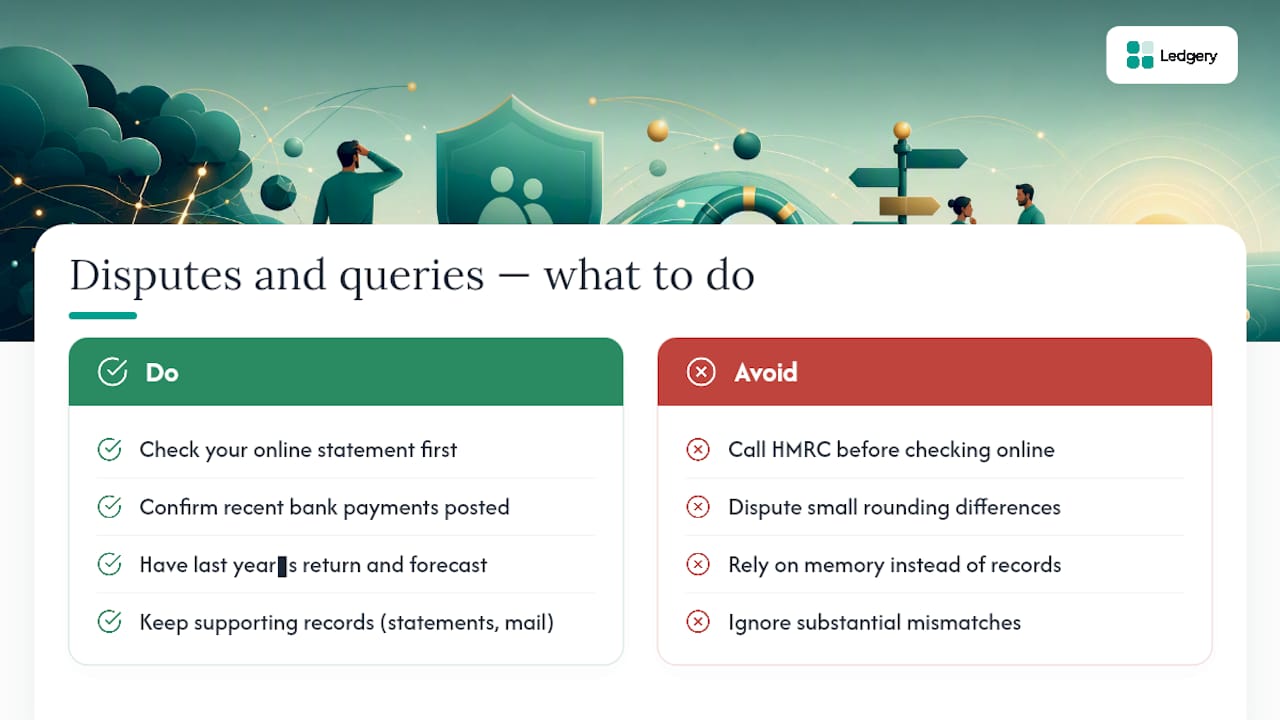
Start by checking your Self Assessment statement of account online before contacting anyone. Discrepancies often come down to a payment posting later than expected, particularly bank transfers, or a reduction claim not yet processed. If the figures still look wrong after that, HMRC’s helpline can walk through the calculation, and it’s worth having your previous year’s tax return and this year’s forecast to hand when you call.
Genuine calculation errors do happen, particularly around the treatment of capital gains or student loan repayments, both of which should be excluded from the relevant amount but occasionally get caught up in it. If you believe HMRC has miscalculated your PoA, you can query it formally, and the internal rules governing how officers reassess these figures are set out in manual SAM1010.
Keep every record that supports your position: bank statements showing when a payment cleared, your own income forecast if you reduced a payment on account, and any correspondence with HMRC. Rounding differences between the two instalments are normal and get carried onto the second payment automatically, so a small discrepancy there isn’t usually worth disputing. A dispute is worth raising when the gap is substantial or when HMRC’s figure doesn’t match the liability shown on your own tax return.
Impact on the self-assessment filing process
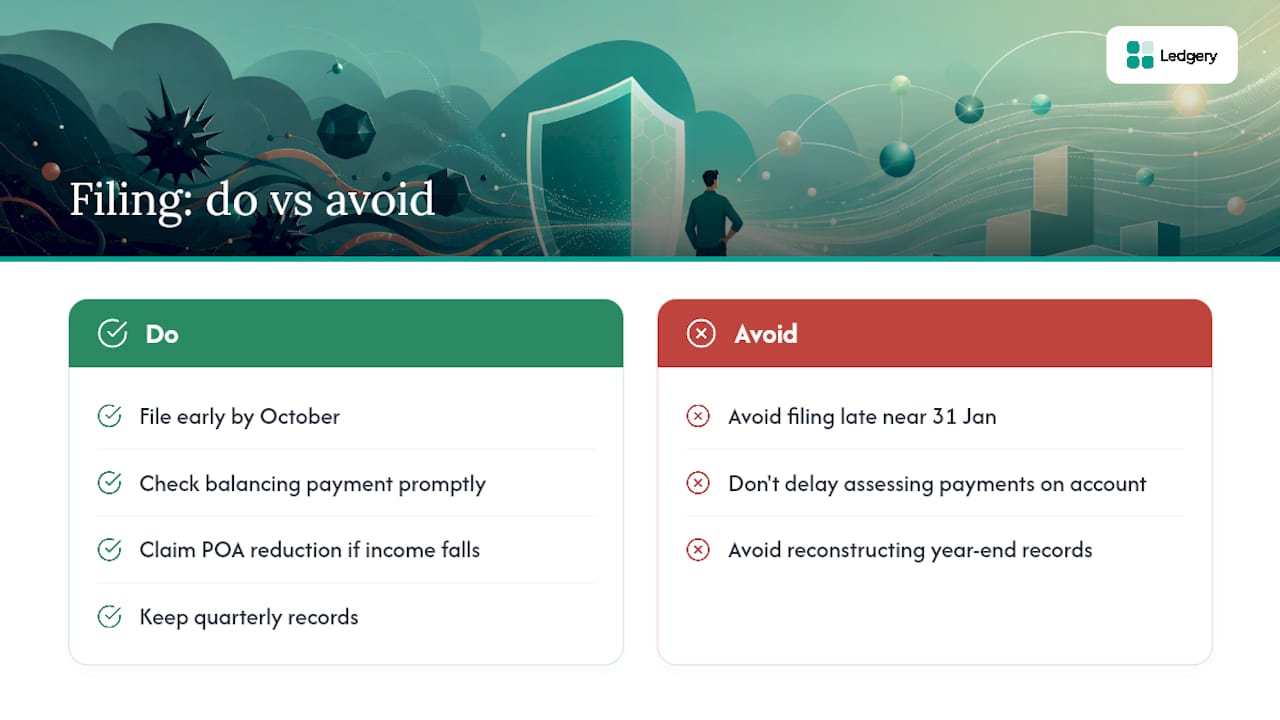
Payments on account don’t change what you report on your tax return, but they change what you owe once you’ve filed it. Your return calculates your actual liability for the year; HMRC then compares that figure against whatever you’ve already paid through your two instalments and works out the balancing payment automatically. File early and you get early clarity on that number, which is one of the strongest arguments for not leaving your return until January.
Filing late has a knock-on effect specifically because of this mechanism. If you don’t know your actual liability, you can’t judge whether your payments on account were set at a sensible level for the following year, and you lose the window to submit a reduction claim before the first instalment falls due. Filing your return in, say, October rather than January gives you three extra months to plan for the 31 January bill, adjust a payment on account if your income has genuinely dropped, and avoid discovering a large balancing payment with no notice.
Consistent quarterly record keeping throughout the year makes this far less stressful, because your estimated liability stays current instead of being reconstructed from twelve months of receipts in one sitting.
The Ledgery view on avoiding payments on account surprises
Most payments on account problems come down to timing, not the rules themselves. If you don’t know your profit until your accountant totals it up in January, you’ve lost the chance to reduce a payment or plan for the cash hit.
Ledgery’s receipt scanning and quarterly HMRC-ready updates keep a running picture of your profit throughout the year, so you can see whether a reduction claim is justified long before the deadline. Deadline alerts cover the 31 January and 31 July dates directly. That said, if your situation involves capital gains, multiple income sources, or a genuine dispute with HMRC, a qualified accountant is still the right call.
— Jason
Try Ledgery to reduce surprises: free first quarter
Ledgery gives you the one thing most payments on account problems come down to: knowing your profit before HMRC’s deadline forces the question. Snap a photo of a receipt and it’s logged, categorised, and rolled into a quarterly update ready for Self Assessment, so your reduction claim (if you need one) is based on real numbers rather than a guess made in January.
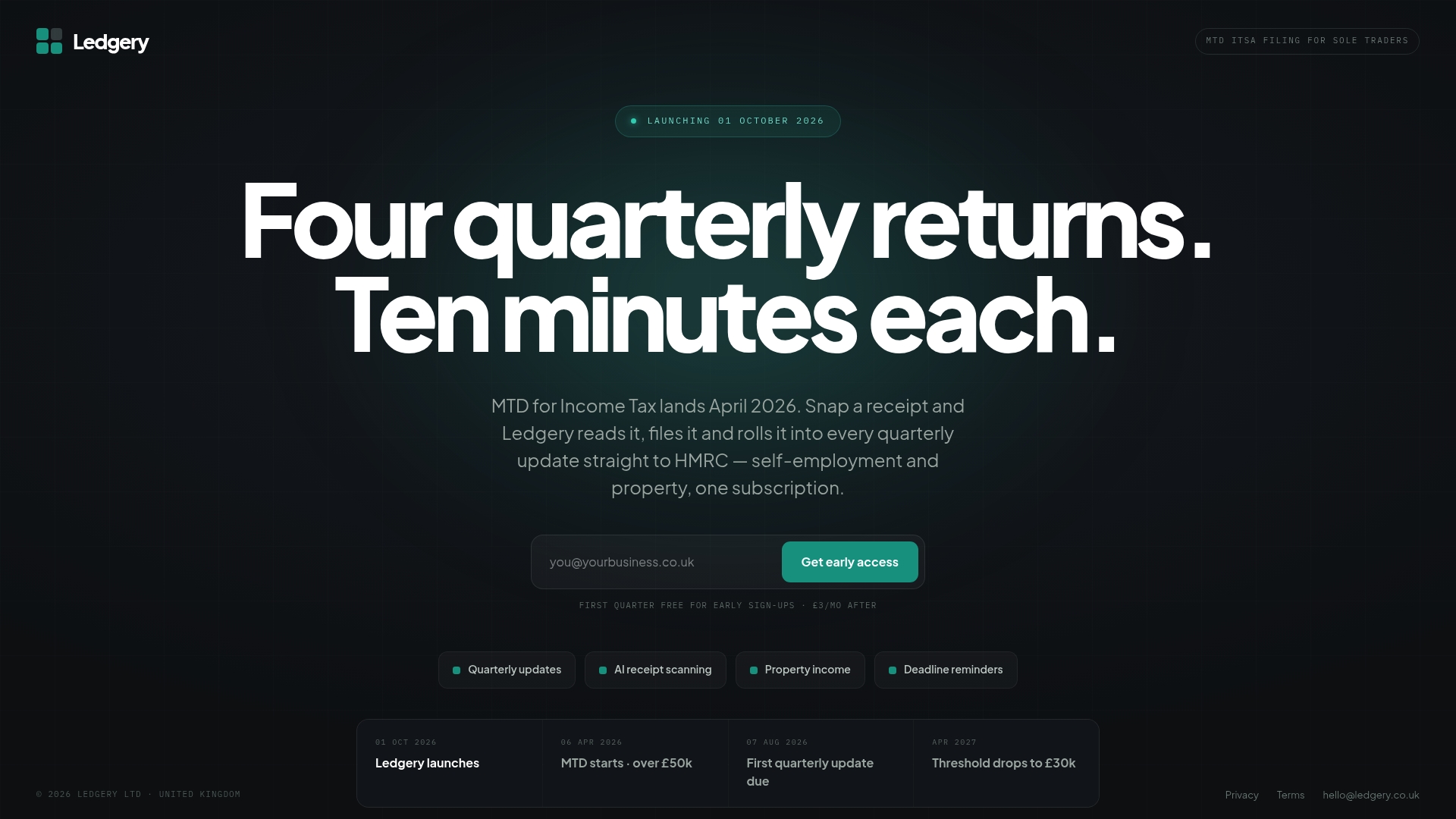
The free first quarter means you can see exactly how this works with your own income before paying anything, with clear profit visibility, deadline alerts for both instalment dates, and export-ready figures when your return is due. If you’re tired of discovering your balancing payment the same week it’s due, visit the Ledgery landing page and start your free quarter.
This article is general information, not a substitute for advice from a qualified financial advisor. Consult a qualified financial professional about your own circumstances before acting on anything here.
Recommended
Self-employment and property income in one subscription, first quarter free. Join the early access list and we’ll email you once, when it opens.
Join early access