MTD Ready Checklists: HMRC Record Keeping Rules for UK Taxpayers

Anyone who submits a Self Assessment return or runs a business must keep tax records, in paper or digital form. The general rule is to keep records for a period of at least five years after the 31 January following the tax year the records relate to. Limited companies keep records for at least six years from the end of their accounting period. From 6 April 2026, some sole traders and landlords must also use Making Tax Digital software to store records digitally and send quarterly updates.
TL;DR:
- Record keeping deadlines depend on the filing date, with five years generally starting from 31 January after the tax year, but late filings extend this period.
- Original documents such as dividend vouchers, import paperwork, and certificates must be kept physically, while other records can be scanned or photographed as long as they are legible.
- From April 6, 2026, sole traders and landlords affected by Making Tax Digital must store records digitally, send quarterly updates, and use compliant software tools.
- Limited companies must retain detailed asset, debt, and statutory records for six years from the end of the relevant financial year, especially if assets are long-lived or in active enquiry.
- Poor record keeping can lead to penalties of up to £3,000 per failure, emphasizing the importance of consistent, backed-up documentation and proactive compliance.
Table of Contents
- HMRC record keeping rules: what documents count as records
- How long to keep records for tax purposes: the exact calculation
- Acceptable record formats and getting ready for Making Tax Digital
- What to do when records are lost, damaged or incomplete
- Company and accounting records: what directors must retain
- How poor record keeping increases your penalty risk
- Quick-start checklists for self-employed people, landlords and employees
- Ledgery: an automated route to compliant record keeping
- VAT-registered versus non-VAT registered: what changes
- Recording expense claims and mileage correctly
- Capital assets and depreciation: what evidence to keep
- Freelancers and contractors: where the rules differ slightly
- Where HMRC guidance changes and how to stay current
- A note on treating records as protection, not paperwork
- Ledgery: try compliant record keeping without the admin
- Where to check the official rules
- Sources
HMRC record keeping rules: what documents count as records
HMRC does not expect a filing cabinet full of guesswork. It expects specific documents that back up every figure on your return, and the type of income you earn decides what those documents look like.
If you’re self-employed, you need sales invoices, purchase invoices, receipts, till rolls and bank statements covering business transactions. Anyone who has been employed at any point in the tax year should hold onto a P60, P45, or P11D, along with evidence of any benefits received.
Landlords face a slightly different list. Tenancy agreements, rent records, invoices for repairs, and mortgage interest statements all matter, particularly since finance cost restrictions changed how mortgage interest gets treated. If you’ve disposed of an asset, you also need capital gains evidence: what you paid, what you spent improving it, and what you got when you sold it.
A few originals genuinely need to be kept rather than copied:
- Original dividend vouchers and certificates of tax deducted
- P60s and P45s issued by employers
- Import/export paperwork if you trade internationally
- Certificates for gift aid or pension contributions where the original is requested
Everything else, including receipts and invoices, can be scanned or photographed as long as the copy is complete and legible.
How long to keep records for tax purposes: the exact calculation
The headline figure everyone quotes, five years, is correct, but the starting point trips people up constantly. The clock doesn’t start at the end of the tax year; it starts on 31 January following that tax year.
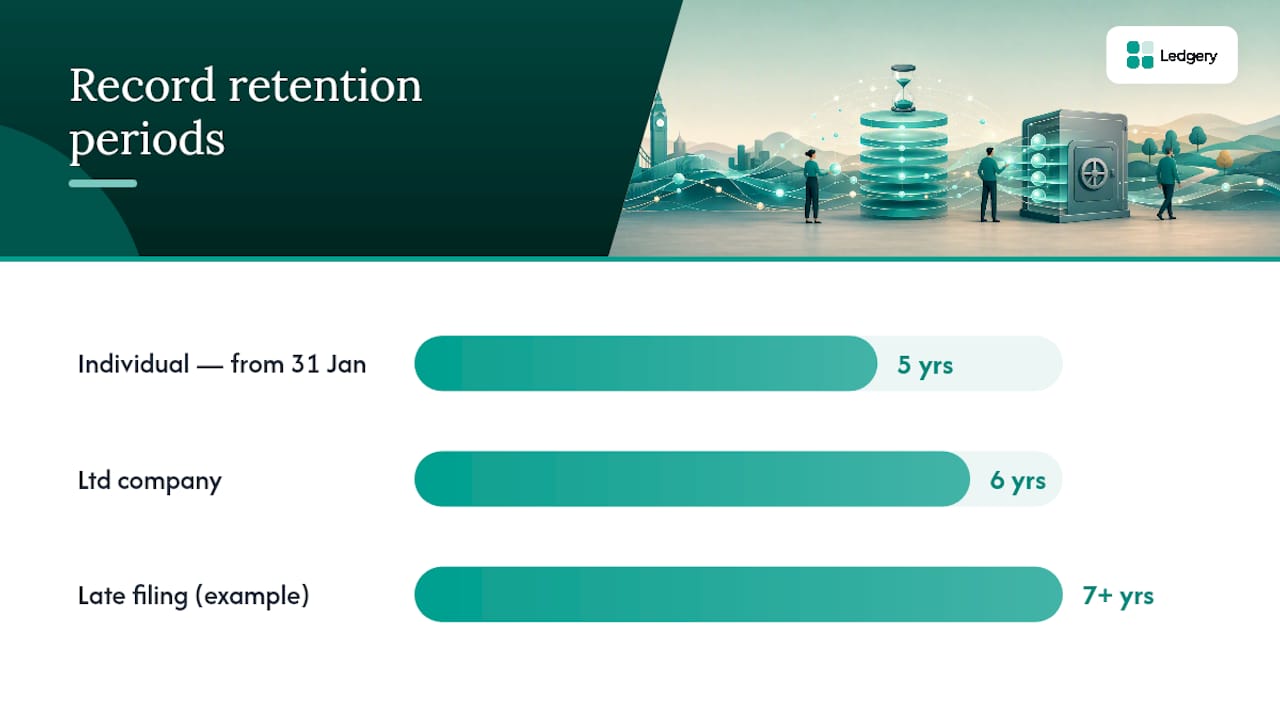
Take a concrete example: if you filed your 2022–23 return online by the January 2024 deadline, you must keep those records until at least the end of January 2029, not January 2028.
A few scenarios extend that deadline:
- Late filing. If your return goes in after the deadline, the retention period runs from the date you actually filed, which can push the cutoff well past the standard five years.
- Open enquiries. SALF211 sets out that records must be kept until the later of several milestones: completion of an enquiry, the date an enquiry window closes, or the standard anniversary date, whichever falls latest.
- Long-life assets. If a piece of equipment or a property sits on your books for a decade, the purchase records need to survive as long as the asset does, plus the standard retention window after disposal.
Statistic to remember: file late, and your five-year clock doesn’t start on the usual date. It starts on your actual filing date, which is why chronic late filers often end up storing records for six, seven, or more years without realising it.
Limited companies work on a separate six-year rule, covered in more detail further down.
Acceptable record formats and getting ready for Making Tax Digital
HMRC doesn’t mind whether your records live in a shoebox or a cloud folder. There are no prescribed rules on physical format: paper, scanned images, spreadsheets, and dedicated software are all fine, provided the record is accurate, complete, and readable. A photograph that cuts off the bottom of a receipt, or a scan too blurry to read the VAT number, doesn’t count as a proper record.
That flexibility narrows for taxpayers brought into Making Tax Digital for Income Tax. From 6 April 2026, affected sole traders and landlords must create and preserve records digitally, use software that’s functionally compatible with HMRC’s systems, maintain digital links between any linked spreadsheets or tools, and send quarterly updates rather than one annual figure.
Three practical routes work for most people:
- Scan every receipt into a clearly labelled folder structure, organised by quarter and category.
- Keep a spreadsheet for transactions and pair it with bridging software for MTD submissions.
- Use a commercial MTD-compatible tool that captures and organises records automatically.
Pro Tip: Name your digital files with a consistent pattern, such as “2026-Q1-Supplies-B&Q-£42.50”, and back everything up to at least two locations. A single hard drive failure shouldn’t be able to wipe out five years of evidence.
What to do when records are lost, damaged or incomplete
Fires, floods, stolen laptops and corrupted hard drives happen. HMRC’s expectation isn’t perfection; it’s that you make a genuine effort to rebuild what’s missing.
- Reconstruct from third-party evidence. Bank statements, supplier invoices, and customer confirmations can rebuild most of a missing sales or purchase ledger.
- Use estimated figures only where necessary. HMRC guidance advises taxpayers to recreate records where possible and to notify the tax office if replacement isn’t feasible; provisional figures are accepted in limited circumstances, but they must be clearly marked as estimates.
- Document your reconstruction method. Keep a note of how you arrived at each estimated figure, since that note becomes evidence in itself.
- Notify HMRC if gaps remain. Contact the relevant tax office rather than quietly submitting a return with unexplained gaps.
Practitioners generally find that a rebuilt record set rarely satisfies HMRC as fully as the original would have. A proactive digital backup is worth far more than an after-the-fact reconstruction, however thorough.
Company and accounting records: what directors must retain
Running a limited company adds a second layer of record keeping on top of personal Self Assessment obligations, and the two overlap more than most directors expect.
Companies must keep:
- Details of assets owned, including anything used to generate income
- Debts the company owes and is owed
- Stock records, including year-end stocktakes and stock movements
- Money received and spent, with supporting invoices and receipts
- Shareholder registers, board minutes, and statutory registers
Companies must retain these accounting records for six years from the end of the last financial year they relate to, longer if the company owns long-life assets, has overlapping accounting periods, files late, or is under an active HMRC enquiry. Corporation Tax returns typically require accounts in iXBRL format, which makes digital record keeping close to unavoidable for most companies regardless of MTD status.
Directors who fail to keep adequate records risk penalties and, in serious cases involving Companies House, disqualification proceedings. It isn’t a rule that gets policed lightly.
How poor record keeping increases your penalty risk
Weak records don’t just slow down your accountant. They actively raise your penalty exposure. Taxpayers who fail to preserve adequate records can face penalties of up to £3,000 per failure, and incomplete records also undermine any “reasonable care” defence if HMRC challenges a figure elsewhere on your return.
Reducing that risk comes down to habits, not luck:
- Keep required originals rather than relying solely on copies.
- Back up digital records in at least two separate locations.
- Write down your record keeping policy, even briefly, so you can show HMRC a consistent process.
- Respond to any compliance check promptly and involve your accountant or agent early.
Statistic to remember: that £3,000 penalty applies per failure to keep records, on top of any separate penalties for inaccuracies or late filing, which is why record gaps rarely stay a single, isolated cost.
Quick-start checklists for self-employed people, landlords and employees
Three shortlists, each built around the documents that matter most for that income type.
Self-employed: sales invoices, purchase receipts, bank statements, mileage log, home-office calculation.
Landlords: tenancy agreements, rent statements, repair invoices, mortgage interest certificates, letting agent statements.
Employees with additional income: P60, P45 or P11D, plus records for any side income reported through Self Assessment.
A simple folder structure covers most digital needs: a top-level folder per tax year, subfolders per quarter, and files named by date and supplier, such as “2026-Q2-Fuel-Shell-£38.20”.
- Photograph the receipt the day you receive it.
- Log the amount, date, and category in your spreadsheet or app.
- File the image into the matching quarterly folder.
- Reconcile against your bank statement at month end.
Ledgery: an automated route to compliant record keeping
Ledgery captures this workflow automatically. Snap a photo of a receipt and it’s organised into the correct quarter, ready for an HMRC update, building an auditable digital trail as you go. Quarterly automation and deadline alerts cut the risk of late filing or last-minute reconstruction. Ledgery suits sole traders and landlords; it doesn’t currently support limited companies or VAT returns.
VAT-registered versus non-VAT registered: what changes
VAT registration adds a distinct layer of record keeping that has nothing to do with your Self Assessment obligations, and conflating the two is a common mistake.
Non-VAT registered businesses only need records that support their Income Tax return: sales, purchases, and expenses, kept for the standard five years after the 31 January deadline. There’s no requirement to break figures down by VAT rate or track input and output tax separately.
VAT-registered businesses must additionally keep a VAT account showing output tax charged and input tax reclaimed, copies of all VAT invoices issued and received, records of any VAT adjustments, and details of any goods given away or taken for personal use. These records generally need retaining for six years, longer than the standard Income Tax minimum, because VAT assessments can be raised further back than Income Tax enquiries in some circumstances.
The practical difference shows up most in invoicing. A VAT invoice needs specific fields beyond a normal receipt: your VAT registration number, the VAT rate applied, and the VAT amount shown separately from the net price. A non-VAT registered trader’s invoice can be far simpler, showing only the total charged.
If you’re near the VAT threshold and expect to register soon, it’s worth adopting VAT-standard invoicing early. Retrofitting a year’s worth of receipts to extract VAT-compliant detail after registration is far more tedious than building the habit from day one.
Recording expense claims and mileage correctly
Expense records fail HMRC scrutiny more often through vagueness than dishonesty. A card statement showing “£64.20, fuel station” doesn’t prove business use; the underlying purpose does.
For general expenses, keep the receipt itself, plus a note of what the purchase was for and which client or project it relates to if that’s not obvious. Round sums or estimated figures without supporting paperwork are the first thing an HMRC compliance check will query.
Mileage works differently and rewards discipline. Rather than tracking fuel receipts, most self-employed people use HMRC’s simplified mileage rates, which means the record that matters is the mileage log itself, not the pump receipt. A compliant log needs the date, start and end points, purpose of the journey, and total miles for each trip. A single annual estimate (“about 6,000 miles for the year”) won’t survive an enquiry; a trip-by-trip log will.
Keep mileage logs and expense receipts for the same five-year period that applies to your other Self Assessment records, since they’re evidence supporting the same return. Where an expense is used partly for business and partly personally, such as a mobile phone contract, note the split and the reasoning behind it at the time, not retrospectively when a query arrives months later.
Capital assets and depreciation: what evidence to keep
Capital assets create a longer, more layered paper trail than day-to-day expenses because the record needs to survive the entire life of the asset, not just the year it was bought.
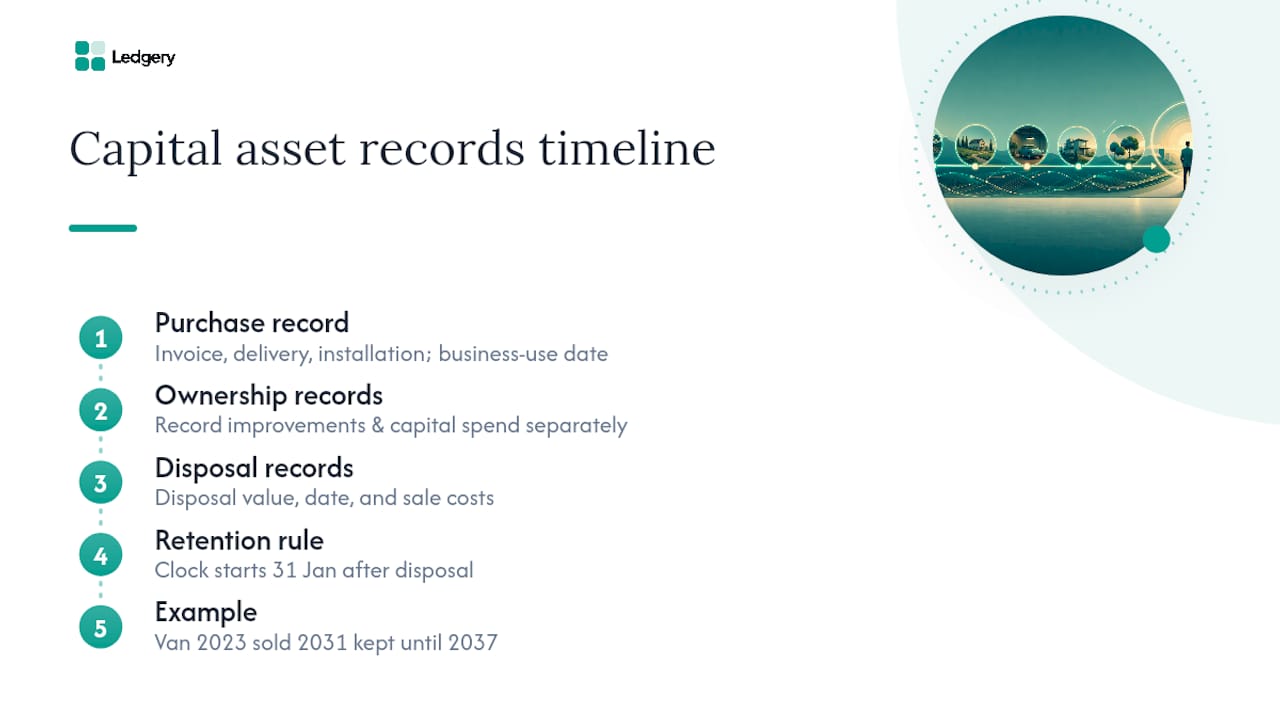
At purchase, keep the invoice showing the price paid, delivery costs, and any installation charges that form part of the asset’s cost. Note the date the asset came into business use, since that date can matter for capital allowance timing. Throughout ownership, keep records of any improvements or additional capital expenditure, separate from ordinary repair costs, which are treated differently for tax purposes.
When the asset is eventually sold, scrapped, or otherwise disposed of, you need the disposal value, disposal date, and any costs incurred in the sale itself. These figures feed directly into capital allowance balancing charges or capital gains calculations, depending on the asset and how it’s used.
The retention rule for capital asset records extends beyond the standard five years in practice, even though the underlying rule is the same: the clock runs from the 31 January after the tax year in which the asset is disposed of, not the year it was bought. A van bought in 2023 and sold in 2031 needs its purchase invoice kept until roughly 2037. Treat every capital asset record as tied to its own, separate retention timeline rather than assuming it expires with the year of purchase.
Freelancers and contractors: where the rules differ slightly
Most record keeping obligations for freelancers and contractors mirror those for any other self-employed person, but a handful of details are worth flagging separately.
Contractors working through intermediaries, particularly in construction, need to keep records relevant to the Construction Industry Scheme, including deduction statements from contractors who’ve paid them. These sit alongside, not instead of, standard business records.
Freelancers juggling several clients simultaneously should keep records organised by client or project, not just chronologically, since HMRC enquiries into specific income sources are easier to answer when your filing system already separates them. A freelancer with five ongoing clients and a messy single spreadsheet will spend far longer responding to a query than one who’s filed invoices by client from the start.
Anyone working close to the IR35 boundary, providing services to a single client in a way that resembles employment, should also retain contracts and working-practice evidence, not just financial records. That evidence matters if HMRC questions employment status rather than the figures themselves.
The retention period stays the same five years after the 31 January deadline as for any other self-employed taxpayer. What changes is the organisation, not the timeline.
Where HMRC guidance changes and how to stay current
HMRC’s published guidance updates regularly, and the shift towards Making Tax Digital means the record keeping rules for many sole traders and landlords will look noticeably different from 6 April 2026 onward compared with previous years.
The most reliable starting points are the GOV.UK guidance pages themselves: keeping your pay and tax records for the general position, the self-employed records guidance for retention periods, and the company and accounting records page for limited company duties. For the legal detail behind retention rules, HMRC’s internal manual entry SALF211 sets out the statutory conditions.
Anyone approaching the MTD threshold should bookmark the software guidance page, since HMRC updates the list of compatible software providers as new tools reach market. If a situation is genuinely unusual, a lost record set spanning several years, or a dispute over what counts as a capital improvement, contacting HMRC directly or speaking to an accountant beats relying on general guidance alone.
A note on treating records as protection, not paperwork
Good record keeping rarely gets credit until the moment it prevents a problem. A trader with a complete, organised set of invoices facing a routine HMRC check tends to close that check quickly, simply because every figure has an obvious paper trail behind it. Someone with a shoebox of crumpled receipts faces weeks of reconstruction, and every gap invites another question.
The habit that actually works isn’t an annual scramble in January. It’s a quarterly one: photograph receipts as they arrive, reconcile against your bank statement every few weeks, and file as you go rather than in one exhausting sitting.
— Jason
Ledgery: try compliant record keeping without the admin
Ledgery gives sole traders and landlords a way to build that quarterly habit without manual filing. Snap a photo of a receipt and it’s organised, timestamped, and backed up in the cloud, turning scattered paperwork into the kind of auditable trail this guide has described throughout.

Every account starts with a free first quarter, so you can test the receipt scanning and quarterly organisation with a small batch of real records before committing to anything. Deadline alerts flag your upcoming submissions automatically, which matters most for anyone approaching the £50,000 income threshold where MTD obligations bite hardest. Ledgery currently supports sole trader and property income; it isn’t built for limited companies or VAT returns, so check that fits your situation before signing up. Head to the Ledgery landing page to start your free quarter and see how your own records look once they’re organised automatically.
Where to check the official rules
For the full detail behind any figure in this guide, go directly to GOV.UK’s self-employed records page, SALF211, or contact HMRC for case-specific queries.
Self-employment and property income in one subscription, first quarter free. Join the early access list and we’ll email you once, when it opens.
Join early access