Joint property tax: who pays what and how to change it

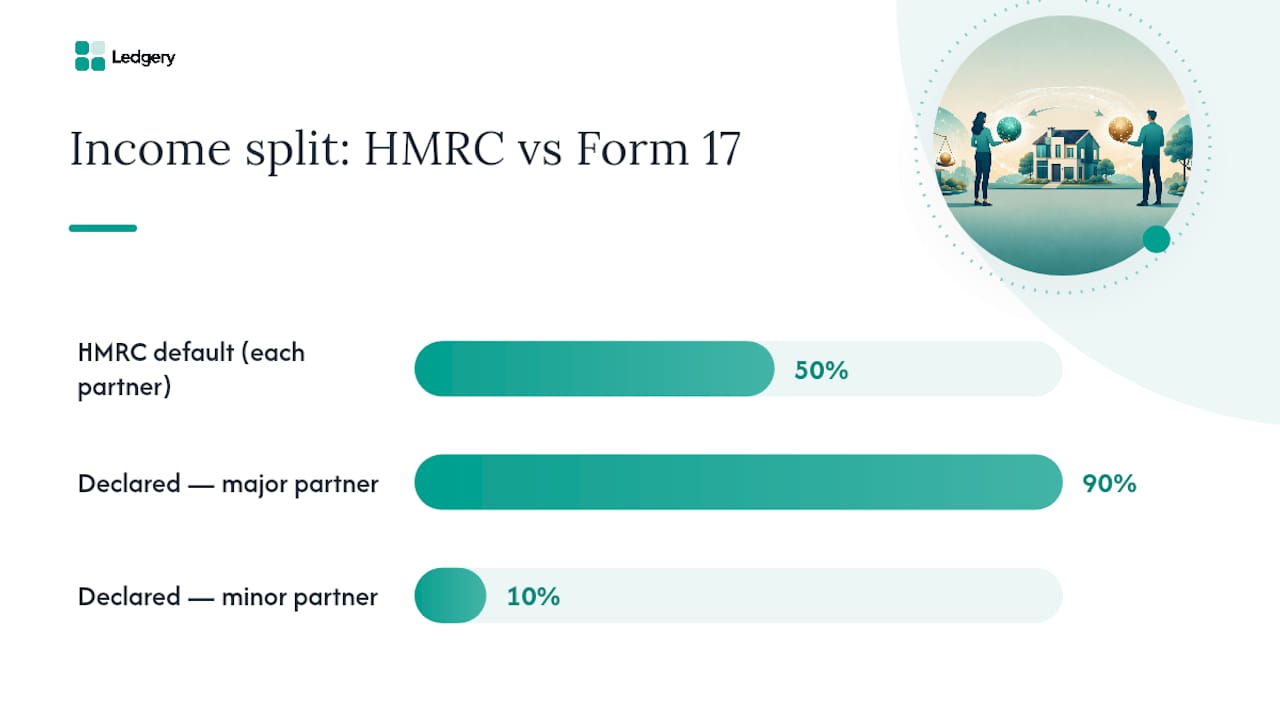
HMRC taxes income from jointly owned property according to legal and beneficial ownership, not according to who manages the property or receives the rent into their bank account. Married couples and civil partners living together are taxed on a default 50/50 split regardless of the actual ownership percentage, unless they file a Form 17 election backed by evidence. Unmarried co owners, family members, and business partners are taxed according to their actual ownership share.
Before you do anything else:
- Check your legal title. Are you registered as joint tenants or tenants in common with HM Land Registry?
- Confirm whether you’re married or in a civil partnership and living together, since this triggers the default 50/50 rule.
- Decide whether you need a Form 17 election or a declaration of trust to reflect your real ownership shares, using GOV.UK guidance and LITRG’s explanation as your starting point.
Key Takeaways
Joint property tax follows legal and beneficial ownership, not who collects the rent, and married couples need a valid Form 17 election to be taxed on anything other than a 50/50 split.
| Point | Details |
|---|---|
| Check your ownership type first | Confirm joint tenants versus tenants in common at HM Land Registry before assuming a tax split. |
| Married couples default to 50/50 | This applies regardless of actual ownership share unless a valid Form 17 election is filed. |
| Form 17 needs evidence and timing | Submit within 60 days of signing, backed by a declaration of trust or deed. |
| CGT usually follows the same split | A Form 17 declaration is normally used by HMRC to apportion gains on a later sale too. |
| Keep records centralised | Tools like Ledgery help store deeds, receipts, and Form 17 evidence alongside quarterly HMRC updates. |
Table of Contents
- How ownership type shapes your joint property tax bill
- The 50/50 rule for couples and how Form 17 changes it
- Reporting rental income and splitting expenses on Self Assessment
- How Capital Gains Tax is split when you sell
- What happens to the tax position when a co-owner dies
- Changing your ownership split: the legal steps involved
- Pitfalls to avoid and questions worth asking an adviser
- Frequently asked questions
- Sources
How ownership type shapes your joint property tax bill
Three terms decide how HMRC splits your tax bill, and confusing them causes most of the problems landlords run into.
Joint tenants own the whole property together, with no defined individual shares. Tenants in common own specific, identifiable shares, which might be equal or might be 70/30, 80/20, or any split recorded in a deed. Beneficial ownership is the economic reality of who actually benefits from the property, which can differ from whose name sits on the legal title at HM Land Registry.
Tax treatment follows accordingly. Joint tenants who aren’t married report income equally by default. Tenants in common report income according to their registered ownership percentage. Beneficial owners are taxed on their beneficial share even when it doesn’t match the legal title, which HMRC’s Property Income Manual sets out clearly.
A worked example makes this concrete. Say two siblings hold a rental flat as tenants in common with a 60/40 split, and the property generates £12,000 in rental income after allowable costs.
- The 60% owner reports £7,200 and pays tax on it at their own marginal rate.
- The 40% owner reports £4,800 at theirs.
- Allowable expenses, such as letting agent fees or insurance, get apportioned in the same 60/40 ratio, not split evenly.
The practical differences stack up fast:
- Reporting: each owner completes their own Self Assessment return based on their share.
- Expenses: apportioned by ownership percentage, never by who happened to pay the invoice.
- Capital Gains Tax on sale: calculated on each owner’s share of the gain, following the same ratio used for income.
The 50/50 rule for couples and how Form 17 changes it
Married couples and civil partners who live together are taxed on rental income from jointly held property on a strict 50/50 basis, regardless of how much each partner actually owns, unless a valid Form 17 election is on file with HMRC.
This catches out plenty of couples who’ve structured ownership deliberately, perhaps giving one partner 90% of a buy-to-let to use their lower tax band, only to find HMRC still assumes an even split by default. Form 17 fixes this by declaring your actual beneficial shares.
The process runs in a defined sequence:
- Establish your unequal beneficial interests through a declaration of trust or deed, ideally solicitor-drafted.
- Complete Form 17, stating the actual percentage each of you owns.
- Both owners sign the form.
- Submit it to HMRC within 60 days of the date you both sign, along with supporting evidence.
HMRC expects specific documentation before accepting the election, including legal proof showing the unequal split.
- Evidence the beneficial ownership genuinely matches what’s declared, not just a paper exercise.
- Both signatures, correctly witnessed where required.
Common errors include missing the 60 day window, submitting a form without underlying evidence, or assuming a joint tenancy automatically qualifies (it doesn’t, since joint tenants have no defined shares to declare). Late or unsigned submissions are a frequent reason HMRC rejects an election.
Pro Tip: A Form 17 election is normally treated as permanent for that property. It stays in force until there’s a genuine change in beneficial ownership, and HMRC will usually apply the same split when calculating Capital Gains Tax on a future sale, so think beyond this year’s income tax bill before you file.
Reporting rental income and splitting expenses on Self Assessment
The commonest mistake is treating expenses as belonging entirely to whoever paid the bill. If one owner pays the buildings insurance from their personal account, that cost still gets apportioned according to the ownership ratio, not claimed in full by the payer, a point tax guidance on splitting rental income makes repeatedly because so many landlords get it wrong.
Typical deductible expenses to apportion include:
- Mortgage interest (subject to the finance cost restriction rules).
- Repairs and maintenance.
- Landlord insurance.
- Letting agent or management fees.
For our earlier 60/40 example, each owner would enter their own share, £7,200 and £4,800 respectively, as property income on their own return, alongside their share of each expense line, rather than the gross rent and the gross costs.
One further wrinkle: if you and a co-owner are running the letting as an active business, with shared decision-making, reinvestment, and a genuine partnership arrangement, the income may need to be treated as partnership income rather than simple co-ownership income. That distinction affects which return the income goes on and how losses can be used, so it’s worth raising with an accountant if your arrangement looks more like a business than a passive letting.
How Capital Gains Tax is split when you sell
Take a property that’s sold with a £100,000 gain, held 70/30 under a declaration of trust. If the split had instead been declared as 60/40 on Form 17, HMRC would typically follow that same ratio for the CGT calculation too, which is why the earlier point about permanence matters so much.
Before finalising a split purely to save income tax, weigh up:
- Private Residence Relief, if the property has ever been your main home.
- The annual exempt amount available to each owner individually.
- Whether letting relief still applies to your circumstances, since eligibility has narrowed considerably in recent years.
What happens to the tax position when a co-owner dies
Ownership type decides what happens on death, and it happens automatically rather than through a will in one of the two cases.
Under joint tenancy, the property passes to the surviving owner by operation of law, known as survivorship, regardless of what any will says.
Practical steps for survivors and executors:
- Check the title at HM Land Registry to confirm which form of ownership applied.
- Notify HMRC of the change and update Self Assessment reporting from the date of death.
- Check the will and, for tenants in common, begin the probate process for the deceased’s share.
- Consider whether the transfer affects Inheritance Tax, since the value of the deceased’s share forms part of their estate for IHT purposes even under survivorship.
Lifetime transfers or declarations made before death can also affect the final IHT position, so it’s worth reviewing ownership structure well before it becomes urgent.
Changing your ownership split: the legal steps involved
Changing how a property is owned, rather than just how income is taxed, usually requires severing a joint tenancy, drafting a new declaration, and updating the register.
- Speak to a solicitor, or use a properly drafted template, to prepare a deed of trust or declaration setting out the new shares.
- If you’re currently joint tenants, serve a notice of severance to convert to tenants in common first.
- Sign and, where required, have the deed witnessed.
- Register the change with HM Land Registry.
- Submit or update your Form 17 election if the change affects a married couple’s tax split.
Solicitor fees for a straightforward declaration of trust are typically moderate but can vary, and the process typically takes a few weeks from instruction to registration. Keep copies of every signed document, since HMRC can ask for them years later.
Pitfalls to avoid and questions worth asking an adviser
Most joint property tax problems trace back to a handful of recurring mistakes.
- No declaration of trust exists to back up an unequal split, so HMRC falls back on the default.
- Form 17 was submitted late, unsigned, or without supporting evidence.
- Income from an active letting business gets reported as simple co-ownership income when partnership rules should apply.
- Expenses are claimed by whoever paid them rather than apportioned by ownership share.
Keep signed deeds, a paper trail of who paid what into which account, and copies of every HMRC submission. If a dispute ever arises, that evidence is what settles it.
Before seeing a solicitor or tax adviser, take a short list of questions:
- Does our current legal title match how we actually want income taxed?
- Do we need to sever a joint tenancy before making any changes?
- What evidence will HMRC expect if we’re ever asked to justify our split?
- How will this income split affect Capital Gains Tax when we eventually sell?
- Could our arrangement count as a partnership rather than co-ownership?
Pro Tip: Don’t choose an income split purely to minimise this year’s tax bill. Because a Form 17 election is usually permanent and tends to carry through to CGT calculations, it’s worth thinking about where you’ll be in ten years, not just April.
Why documentation matters more than the split itself

The tax rules around jointly owned property aren’t complicated in principle. Where people come unstuck is evidence: an unequal split that exists only in conversation, never in a signed deed, is one HMRC can simply disregard. Getting the paperwork right at the outset, rather than reconstructing it under pressure years later, is the single biggest factor separating a smooth Self Assessment from a stressful one.
Aligning your legal ownership, your beneficial ownership, and what you actually tell HMRC isn’t a box-ticking exercise. It’s what protects you if your circumstances or the property’s value change.
Keeping evidence organised without the admin headache
A digital record-keeping tool doesn’t change who legally owns a property or alter your Form 17 split, but it does make the evidence trail far easier to produce when HMRC or a solicitor asks for it. Storing deeds, receipts, and proof of who paid which expense in one place removes a lot of the scramble that happens when records are split across email inboxes and old bank statements. This isn’t a substitute for legal or tax advice on your ownership structure, but it does reduce the administrative risk once that structure is in place.
Ledgery is built for exactly this kind of ongoing recordkeeping, particularly for landlords already juggling quarterly HMRC updates under Making Tax Digital. It scans receipts automatically, files them into organised expense categories that map onto the apportionment rules above, and sends deadline alerts so a Form 17 submission window or a Self Assessment deadline doesn’t slip past unnoticed. Ledgery also gives you a central place to store deeds and Form 17 evidence alongside your everyday income and expense records, which matters if HMRC ever queries your split years down the line. If you’re a co-owner earning property income and want your records ready before you next need them, start with Ledgery’s free first quarter.
Frequently asked questions
Do unmarried joint owners get the same 50/50 default as married couples? No. The automatic 50/50 rule applies specifically to married couples and civil partners living together.
Can we submit Form 17 if we own the property as joint tenants? No. Joint tenants have no defined individual shares to declare, so you’d need to sever the joint tenancy and register as tenants in common with an unequal split before Form 17 becomes relevant.
What happens if we forget to update Form 17 after buying out more of a share? HMRC will likely continue applying the old split until a new, valid declaration and evidence are submitted, so it’s worth updating your Form 17 as soon as ownership shares change materially.
Does a Form 17 election affect Inheritance Tax as well as income tax? Not directly, but the beneficial ownership shares it confirms can influence how a deceased owner’s estate is valued for Inheritance Tax purposes, particularly under tenants in common arrangements.
This article is general information, not a substitute for advice from a qualified financial advisor. Consult a qualified financial professional about your own circumstances before acting on anything here.
Sources
- Joint income from property | Low Incomes Tax Reform Group
- What kind of joint ownership do I have? - HM Land Registry blog
Recommended
Self-employment and property income in one subscription, first quarter free. Join the early access list and we’ll email you once, when it opens.
Join early access