Mileage allowance for the self-employed: 2026/27 guide

Yes, as a sole trader you can claim a mileage allowance against your taxable profit. For 2026/27, the HMRC approved rate for cars and vans is 55p per mile for the first 10,000 business miles, dropping to 25p per mile after that. Motorcycles attract 24p per mile; bicycles 20p. These are the simplified (flat-rate) figures under HMRC’s simplified expenses scheme, and they apply retrospectively from 6 April 2026.
Two quick exclusions to flag before you read further:
-
Commuting — travel between your home and a fixed, regular workplace does not count as a business mile.
-
Capital allowances — if you have already claimed capital allowances on a vehicle, you cannot also use the flat-rate mileage method for that same vehicle.
Key takeaways
Sole traders can claim the HMRC mileage allowance at 55p per mile for the first 10,000 business miles in 2026/27, reducing taxable profit with minimal admin when records are kept consistently.
| Point | Details |
|---|---|
| 2026/27 headline rate | 55p per mile for the first 10,000 business miles; 25p per mile after that. |
| Retrospective from 6 April 2026 | Miles logged earlier in the year at the old rate are eligible for the higher 55p rate. |
| Commuting is excluded | Travel between home and a fixed, regular workplace does not count as a business mile. |
| No double-dipping | Claiming the flat rate means you cannot also claim fuel, insurance or capital allowances for that vehicle. |
| Ledgery simplifies records | Ledgery’s receipt scanning and quarterly export tools keep mileage and travel expenses organised for Self Assessment. |
Table of Contents
-
What are the current HMRC mileage rates for self-employed people?
-
Who can use simplified mileage and what are the restrictions?
-
The part most guides skip: method consistency matters more than the rate
-
Ledgery keeps your mileage records and tax submissions in one place
What are the current HMRC mileage rates for self-employed people?
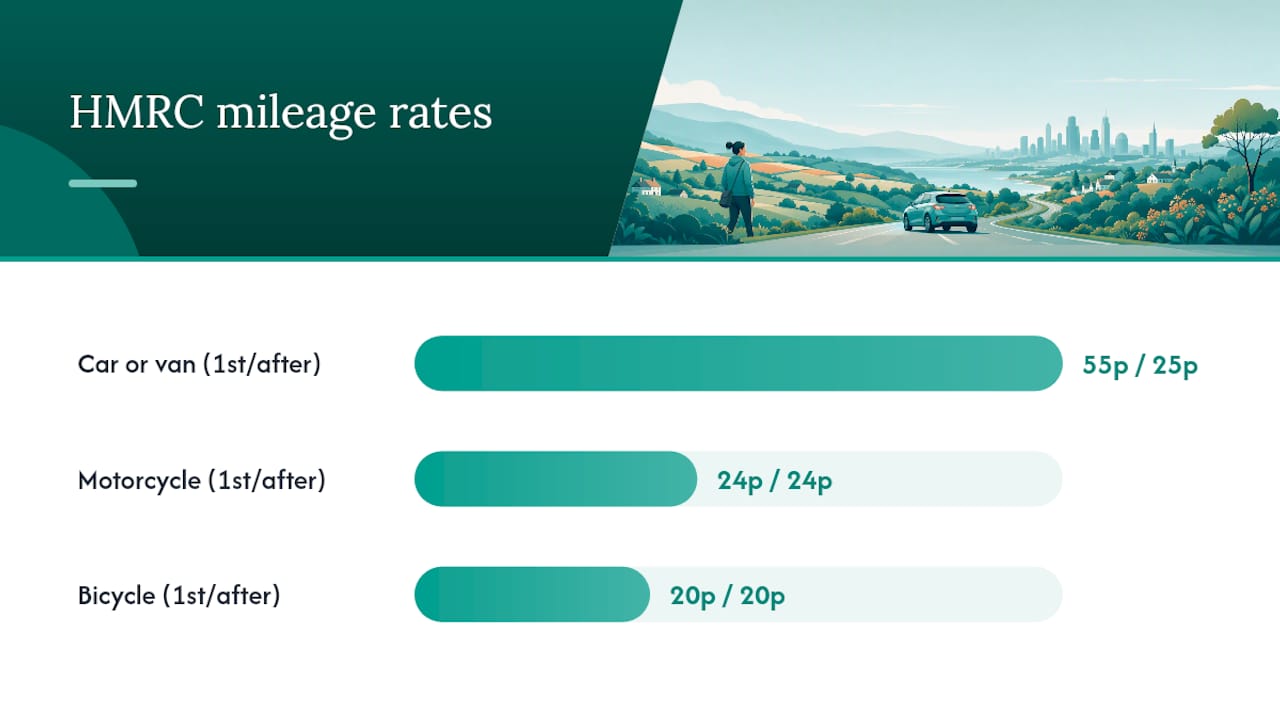
HMRC publishes authoritative rate tables covering cars, vans, motorcycles and bicycles. The figures below are the approved rates for 2026/27.
| Vehicle type | First 10,000 miles | After 10,000 miles |
|---|---|---|
| Car or van | 55p | 25p |
| Motorcycle | 24p | 24p |
| Bicycle | 20p | 20p |
Worked example 1 — exactly 10,000 business miles
10,000 miles × 55p = £5,500 allowable deduction. That £5,500 comes straight off your trading profit before tax is calculated, so a basic-rate taxpayer saves roughly £1,100 in Income Tax and reduces their National Insurance liability too.
Worked example 2 — 14,000 business miles in a year
-
First 10,000 miles × 55p = £5,500
-
Remaining 4,000 miles × 25p = £1,000
-
Total deduction: £6,500
One important timing point: if you logged miles earlier in the 2026/27 tax year using the old 45p rate, you are still entitled to claim at 55p for those journeys. As IPSE noted, the rise is backdated to 6 April 2026, so accurate records for the full tax year are worth keeping. The government has also signalled a further review of rates at Budget 2026, so check for updates each April.
Which journeys count as business miles?
The governing test is HMRC’s “wholly and exclusively” rule. A journey qualifies when its sole purpose is business. HMRC’s travel expenses guidance confirms that allowable trips include:
-
Visits to clients or customers at their premises
-
Travel to a temporary workplace (somewhere you attend for a limited period or purpose, not your regular base)
-
Deliveries, site visits, and travel between multiple work locations in a single day
-
Travel to training directly related to your trade
What does not count:
-
Your daily commute from home to a fixed office or studio you rent — that is ordinary commuting, excluded regardless of how far it is.
-
Private errands bolted onto a business trip. If you stop at a supermarket on the way back from a client meeting, the detour miles are not claimable.
-
Travel to a permanent second workplace that you attend regularly.
A practical scenario: a freelance photographer who drives from home to a client’s studio (temporary workplace), then to a second client, then home again can claim all three legs. The same photographer driving from home to their own rented studio every morning cannot claim that commute.
Pro Tip: When you note a journey’s purpose, be specific rather than vague. “Client meeting — [Name], [Town]” is far more defensible than “business travel” if HMRC ever queries your records.
Who can use simplified mileage and what are the restrictions?
HMRC’s simplified expenses rules limit the flat-rate method to:
-
Sole traders
-
Business partnerships that do not include a limited company as a partner
Limited companies cannot use simplified mileage at all. If you operate through a company, you need to look at the company’s actual vehicle costs or HMRC’s advisory fuel rates instead.
Key restrictions — tick these off before you start:
-
You cannot use the flat rate for a vehicle on which you have already claimed capital allowances. The HMRC internal manual BIM75005 is explicit: the simplified rate replaces all acquisition, ownership and running costs, so capital allowances and the mileage method cannot coexist for the same vehicle.
-
Once you choose the flat-rate method for a specific vehicle, you must stick with it for that vehicle until you replace it. You cannot switch mid-ownership to actual costs.
-
No double-dipping. When you claim the flat rate, you cannot separately claim fuel, insurance, servicing or road tax for that vehicle. The per-mile rate covers all of those.
-
Mixed-use journeys must be apportioned. Only the business proportion of a trip counts; the private element does not.
The flat rate does not prevent you claiming other travel costs separately, such as train fares, parking charges, tolls or overnight accommodation, provided those costs are wholly for business.
Simplified mileage or actual costs: which method suits you?
The direct answer: use the flat rate when it produces a larger deduction or when you want to cut admin. Use actual costs when your real running expenses exceed what the per-mile rate would give you.
Step-by-step comparison:
-
Estimate your total business miles for the year.
-
Calculate the flat-rate total (first 10,000 × 55p, then remainder × 25p).
-
Add up your apportioned actual costs: fuel, insurance, servicing, repairs, MOT, road tax, and depreciation (or capital allowances if eligible). Multiply by your business-use percentage.
-
Compare the two figures. The higher one is the better deduction.
-
Run the HMRC simplified expenses checker to cross-check your arithmetic for a single vehicle at a time.
Pro Tip: High annual business mileage almost always favours the flat rate after the 55p rise. If you drive 15,000 business miles a year in a modest car, the flat rate gives £6,500 — a figure that is hard to beat on actual costs unless your running costs are unusually high. Conversely, if you have low business mileage but a new, expensive vehicle with high insurance and finance costs, actual costs may win.
The NI Business Info checklist of typical motoring expenses is a useful reference when totalling actual costs: fuel, insurance, servicing, tyres, MOT, road tax, and finance interest (where applicable).
How to include mileage on your Self Assessment return
Enter your flat-rate mileage total as a vehicle expense on the Self Employment pages (SA103) of your Self Assessment return. The figure goes under “Motor expenses” — you do not need to itemise individual journeys on the return itself; your mileage log is the supporting record.
Practical steps:
-
Total your business miles for the tax year, split into the first 10,000 and any miles above that threshold.
-
Multiply: (first 10,000 × 55p) + (excess miles × 25p) = total deduction.
-
Enter that total in the “Motor expenses” box on SA103 (or the equivalent field in your accounting software).
-
If you are using actual costs instead, enter the apportioned running costs in the same box.
-
If you are on the cash basis, follow the relevant HMRC guidance — simplified mileage integrates straightforwardly with cash-basis accounting.
A short note on Mileage Allowance Relief: this applies when an employer reimburses you at less than the approved rate. As a sole trader, you are not an employee of your own business, so Mileage Allowance Relief is not directly relevant — your deduction comes through the trading expenses route above.
What records do you need to keep for mileage claims?
Keep a dated mileage log. HMRC does not prescribe a specific format, but your records must be detailed enough to verify every claim. The minimum fields are:
-
Date of the journey
-
Start point (address or postcode)
-
End point (address or postcode)
-
Business purpose (specific, not generic)
-
Miles travelled (odometer reading at start and finish, or app-recorded distance)
-
Running total for the tax year
If you carry passengers and claim passenger payments, add their names and the reason for travel.
Practical logging options:
-
A spreadsheet with one row per journey — simple, free, and easy to total at year end.
-
A smartphone mileage-tracking app that records GPS routes automatically.
-
A paper logbook kept in the vehicle, transferred to a spreadsheet weekly.
For parking charges, tolls and overnight costs claimed separately, keep the receipts. Scanning them immediately (a photo on your phone is fine) means you will not lose them.
Retention period: keep all records for at least five years after the 31 January filing deadline for the relevant tax year. For the 2026/27 return (due 31 January 2028), that means holding records until at least January 2033.
Common mistakes that attract HMRC attention
Most mileage errors are honest, but a few patterns consistently draw queries.
Frequent errors:
-
Claiming the home-to-office commute as a business mile
-
Claiming fuel or insurance separately while also using the flat rate (double-dipping)
-
Logging miles with no stated purpose (“business travel” alone is not enough)
-
Applying the 55p rate to private journeys
-
Using a single annual odometer figure rather than per-journey records
Red-flag patterns HMRC notices:
-
Claimed mileage that implies more miles than the vehicle’s odometer could support
-
A large, unexplained jump in claimed miles from one year to the next
-
No contemporaneous records — a log reconstructed from memory months later is far weaker than one kept in real time
The corrective actions are straightforward: log every journey on the day, cross-reference with your calendar or diary, and use an app or spreadsheet so the data is timestamped. Honest mistakes can usually be corrected through an amended return. Persistent inconsistency between claimed miles and supporting evidence is what escalates a routine check into a formal enquiry.
Keep your mileage log contemporaneous. HMRC’s own guidance makes clear that records reconstructed after the fact carry significantly less weight than those kept at the time of travel. A five-minute daily habit protects years of legitimate claims.
Practical tools and resources for tracking mileage
Tracking options:
-
A spreadsheet template with columns for date, start, end, purpose, miles and running total covers every HMRC requirement at zero cost.
-
Smartphone GPS apps (search “mileage tracker” on iOS or Android) record routes automatically and can export CSV files for your accountant or Self Assessment software.
-
Digital receipt capture for parking, tolls and accommodation keeps supporting evidence in one place alongside your mileage log.
Authoritative resources to bookmark:
-
HMRC simplified expenses (vehicles) — eligibility rules and the no-switching restriction
-
HMRC mileage and fuel rates — official rate tables updated each tax year
-
HMRC simplified expenses checker — compare flat rate vs actual costs for your vehicle in minutes
Ledgery’s receipt scanning and expense organisation tools let you capture parking receipts and business costs on the go, then export a quarterly summary ready for your Self Assessment entries. For sole traders who want their mileage and other travel expenses in one place without a filing cabinet full of paper, that kind of automated organisation cuts the year-end scramble considerably.
Actionable next step: record one week of journeys using both a spreadsheet and an app, then run the HMRC checker with your estimated annual miles. You will know within ten minutes which method is worth pursuing.
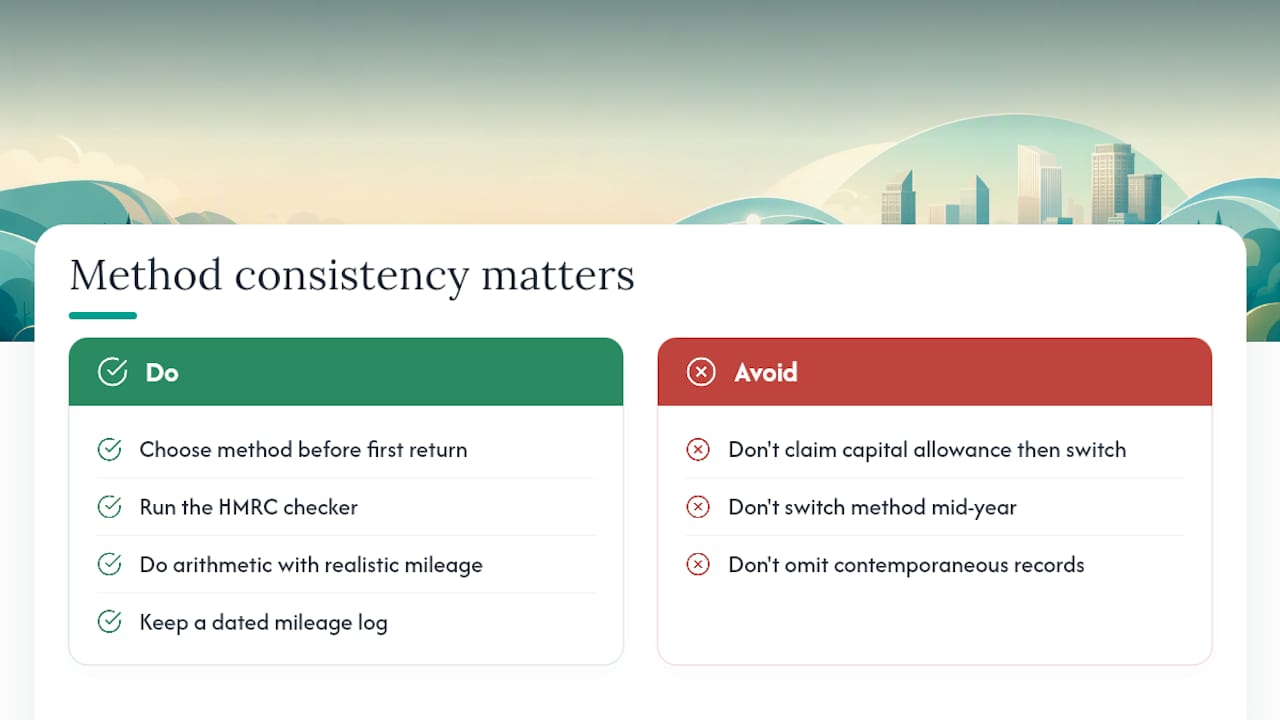
The part most guides skip: method consistency matters more than the rate
The 55p headline grabs attention, and rightly so — it is the first meaningful increase in years. But the decision that actually costs sole traders money is not which rate to use; it is failing to commit to a method consistently and then discovering mid-year that they have inadvertently disqualified themselves from the one they wanted.
Here is the scenario that comes up repeatedly: a sole trader buys a new car, claims the first-year capital allowance because their accountant suggests it, and then tries to switch to simplified mileage the following year because the admin is easier. They cannot. The BIM75005 rules are unambiguous on this. The capital allowance claim locks them into actual costs for that vehicle’s lifetime in the business.
The practical implication is that the method decision should happen before you file your first return for a new vehicle, not after. Run the HMRC checker, do the arithmetic with your realistic annual mileage, and commit. Switching later is not an option; the only reset is a new vehicle.
One more thing worth saying plainly: the record-keeping burden for simplified mileage is genuinely light. A dated log with start point, end point, purpose and miles is all HMRC needs. The traders who get into difficulty are almost always those who kept no contemporaneous records at all, not those who chose the wrong method.
Ledgery keeps your mileage records and tax submissions in one place
Tracking mileage manually is manageable for a few journeys a week. At 50 or 100 trips a year, the spreadsheet discipline slips — and that is precisely when HMRC queries become a problem.
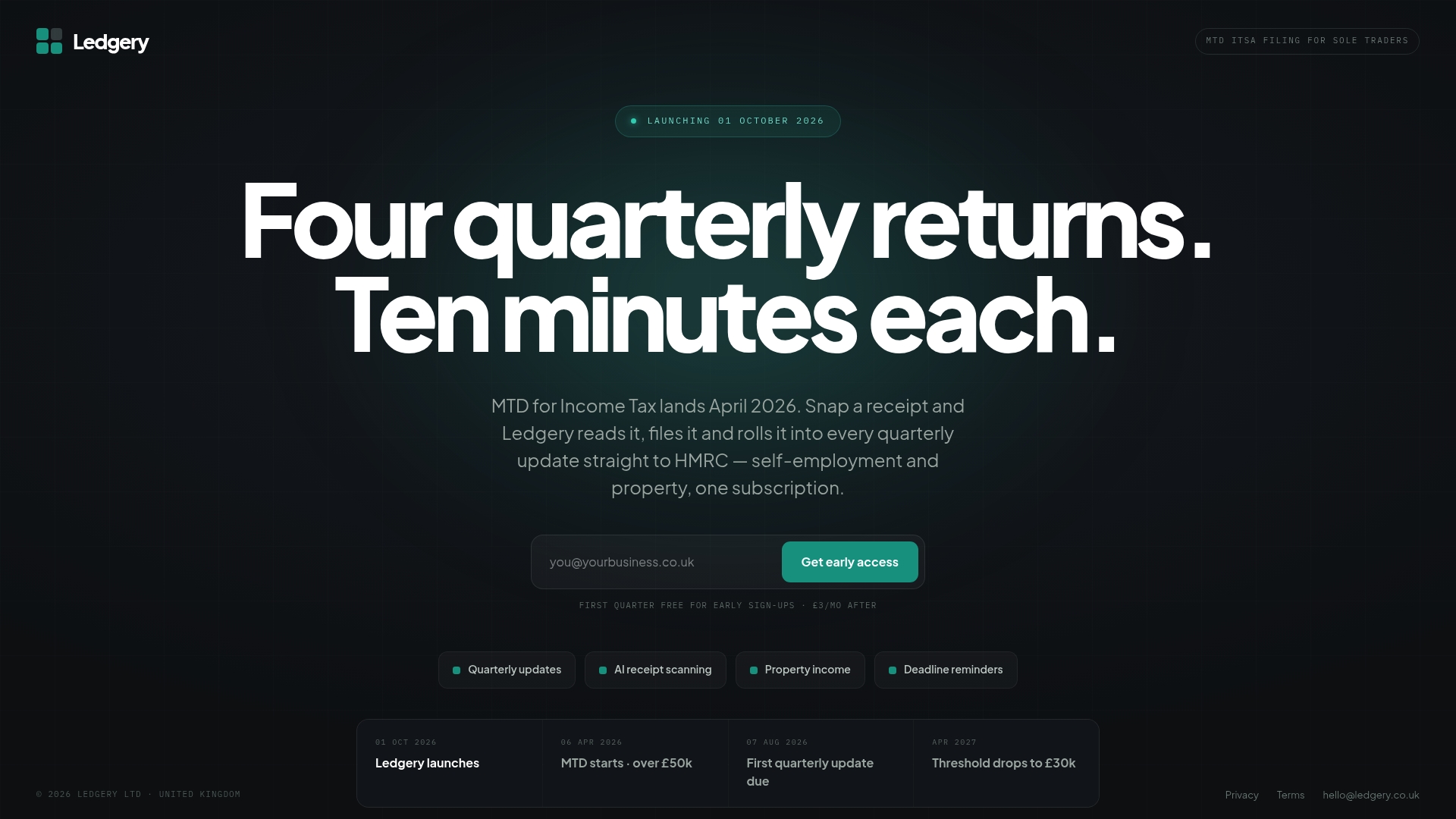
Ledgery is built for sole traders who want their expenses organised without the filing cabinet. Snap a receipt for parking or a toll, and Ledgery logs it alongside your other business costs. At quarter end, your figures are ready to export for your Self Assessment entries, with deadline reminders so nothing slips past the 31 January cut-off. The first quarter is free, so you can test whether it fits your workflow before committing to a subscription.
Start your free quarter with Ledgery and see how much time you recover when your mileage and expenses are organised from day one.
Sources
This article provides general information about HMRC mileage rules for self-employed individuals. It is not a substitute for professional tax advice. If your situation involves company cars, capital allowances, or complex business/private journey splits, consult a qualified accountant or tax adviser, or check directly with HMRC.
Recommended
Self-employment and property income in one subscription, first quarter free. Join the early access list and we’ll email you once, when it opens.
Join early access