UK MTD ITSA: 4 Quarterly Dates, Look Back Test, 2 Month Plan

MTD ITSA quarterly updates are due on 7 August, 7 November, 7 February and 7 May, with the final declaration due by 31 January the following year. Whether these dates apply to you depends on income: the mandate starts 6 April 2026 for income above a higher threshold, with lower thresholds applying in subsequent years at later dates. Check your 2024/25 Self Assessment figures now to see which cohort you fall into.
TL;DR:
- The first MTD ITSA deadline for the 2026/27 year is August 7, applying to those with income above the threshold based on 2024/25 figures.
- Quarterly updates must be cumulative, covering income and expenses for each category, with some software allowing calendar or standard tax year quarters.
- Missing an update from the first year results in no penalties but can delay or block the final declaration, with penalties starting from 2027/28.
- Building weekly bookkeeping habits and choosing the right software early simplifies compliance and prevents last-minute errors.
- Leaving or exemptions require official application and supporting evidence, with no automatic removal from the regime if income drops below the threshold.
Table of Contents
- Key dates and timeline: when do MTD ITSA deadlines fall?
- Who needs to join, and how is the threshold worked out?
- What must each quarterly update and final declaration contain?
- What happens if you miss an MTD ITSA deadline?
- How do you actually meet these deadlines?
- A two-month plan for getting ahead of your next deadline
- How do you leave or deregister from MTD ITSA?
- Where do these deadlines usually go wrong?
- Why quarterly reporting rewards small, boring habits
- Ledgery helps you hit every MTD ITSA deadline without the admin backlog
- Sources
Key dates and timeline: when do MTD ITSA deadlines fall?
The quarters run on fixed periods tied to the tax year, not to whenever you happen to start keeping digital records. Each quarter ends on the 5th of the month, and the update is due exactly one month and two days later, on the 7th. For the first mandated group, joining from 6 April 2026, the schedule for the 2026/27 tax year looks like this:
| Quarter | Period covered | Submission deadline |
|---|---|---|
| Q1 | 6 April – 5 July 2026 | 7 August 2026 |
| Q2 | 6 July – 5 October 2026 | 7 November 2026 |
| Q3 | 6 October – 5 January 2027 | 7 February 2027 |
| Q4 | 6 January – 5 April 2027 | 7 May 2027 |
| Final declaration | Full 2026/27 tax year | 31 January the following year |
These dates come directly from HMRC’s quarterly updates campaign guidance, which sets out the same schedule for every mandated taxpayer regardless of trade or profession.
Some software lets you elect calendar quarters instead (aligning to the 1st of the month rather than the 6th), which suits businesses that already report internally on calendar months. Either way, HMRC allows submissions up to 10 days before a deadline, so nothing forces you to wait until the last moment.
- Standard quarters follow the tax year (6th to 5th)
- Calendar quarters run 1st to the end of the month, if you elect for them
- VAT-registered MTD users follow a separate cycle entirely, so don’t merge the two calendars
Who needs to join, and how is the threshold worked out?
The mandate arrives in three phases, and each one is triggered by a specific figure from a previous tax year, not the current one. HMRC’s phased rollout sets these thresholds, starting with higher income levels and reducing in later years.
Qualifying income means your combined gross turnover from self-employment and property, added together, before expenses are deducted. A sole trader earning £35,000 with a rental property bringing in £18,000 has £53,000 in qualifying income, well past the first threshold, even though neither source alone crosses £50,000. PAYE earnings, pensions, dividends and savings interest don’t count towards this figure.
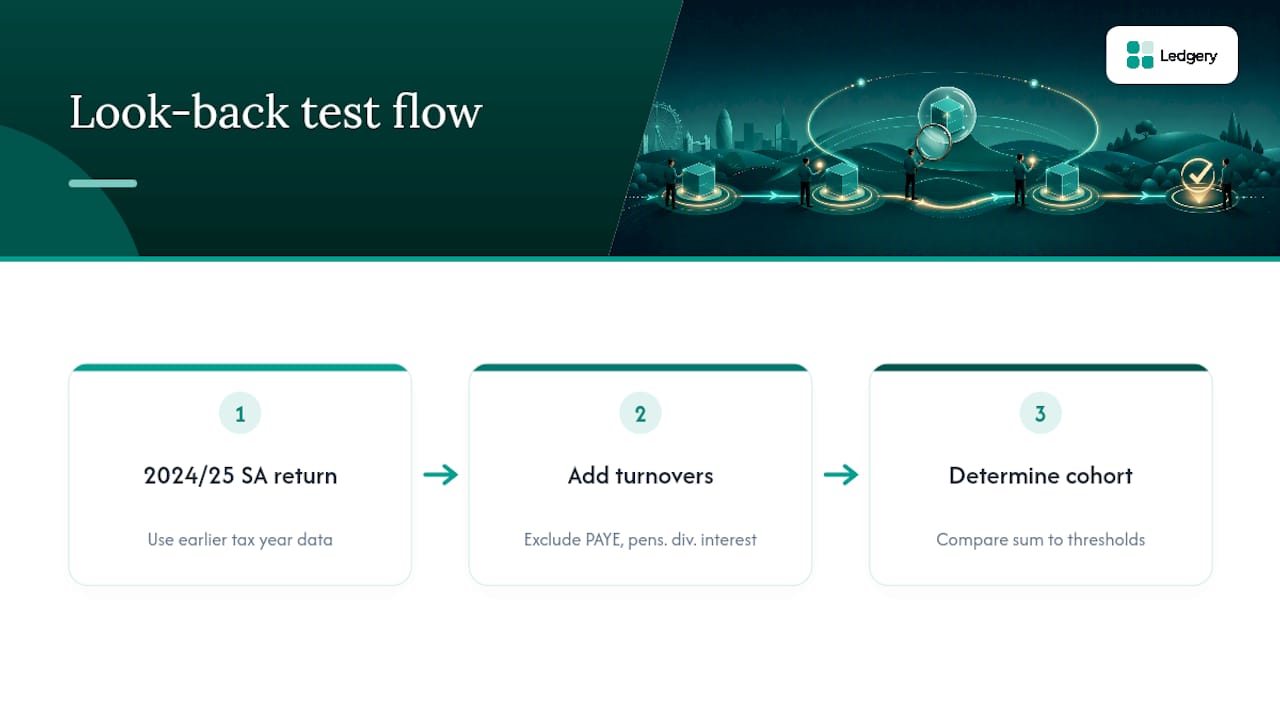
HMRC uses a look-back test based on an earlier year’s Self Assessment return, so the threshold check isn’t something you can defer. Pull up your 2024/25 return now and add your self-employment and property turnover together. That single sum tells you which cohort, if any, you belong to.
What must each quarterly update and final declaration contain?
A quarterly update isn’t a profit calculation. It’s a running total of income and expenses, grouped into the categories HMRC prescribes for your business type, and each update is cumulative rather than a fresh count from zero. HMRC’s guidance on using MTD for income tax confirms the requirement applies separately to each income source, so a sole trader with a rental property submits updates for both.
- Quarterly updates: category totals for income and expenses, one set per income source
- Final declaration: all income sources, plus adjustments like reliefs, allowances and capital gains, replacing the old SA return entirely
- All four quarterly updates must be submitted before the final declaration can go in
Even a quiet quarter needs reporting. Practitioners are clear that a nil return is still required when there’s no income or expense to report, so skipping a quarter because nothing happened isn’t an option. You can correct a submitted update later, either through your software or the next update, but the final declaration is where everything gets reconciled properly.
Pro Tip: Keep a simple running note of which categories you’ve used each quarter. HMRC’s category list doesn’t change mid-year, but it’s easy to misfile an expense in month one and forget how you categorised it by month four.
What happens if you miss an MTD ITSA deadline?
The first cohort gets some breathing room. During the 2026/27 tax year, HMRC will not issue penalty points for late quarterly updates, giving newly mandated taxpayers a genuine soft landing while they adjust. That relief doesn’t extend indefinitely, though, and it doesn’t mean deadlines can be ignored.
- From 2027/28, the points-based penalty regime applies: one point per missed quarterly update
- Four points trigger a penalty according to the points system, with penalties applied after reaching a certain level.
- Points expire after a period of consistent, on-time compliance
- Missing quarterlies, even without a points penalty in year one, can still delay or block your final declaration until the gaps are resolved
That last point matters more than the penalty figures. A backlog of unsubmitted quarters sitting unresolved in October won’t stop you filing, but it will make January miserable.
How do you actually meet these deadlines?
Getting ahead of MTD ITSA is mostly about picking the right tools and building a habit early, before the first deadline is bearing down on you.
- Check your eligibility and sign up on GOV.UK, using your Government Gateway details and prior-year income figures
- Choose HMRC-compatible software, or a bridging tool if you’re attached to spreadsheets, and confirm it handles multiple income sources
- Decide between standard and calendar quarters, most software defaults to standard, and set this once rather than switching mid-year
- Build a weekly habit: scan receipts as they arrive, categorise transactions immediately, don’t let a shoebox of paper accumulate
- Reconcile at the end of each quarter and submit, even if the result is a nil return
- Take advantage of the 10-day early submission window if your records are ready ahead of the deadline
A tool like Ledgery can shorten this list considerably by turning photographed receipts into organised quarterly totals automatically.
Pro Tip: Reconcile weekly, not quarterly. Four hours of quick weekly checks beats one dreaded afternoon trying to remember what a receipt from ten weeks ago was actually for.
A two-month plan for getting ahead of your next deadline
With roughly eight weeks before any deadline, there’s enough time to build proper habits rather than scramble.
- Week 1 to 2: sign up on GOV.UK and select your software
- Week 3 to 4: migrate historic records and set your category structure
- Week 5 to 6: start weekly capture, receipts scanned and categorised as they land
- Week 7: run a mid quarter reconciliation check
- Week 8: confirm final figures, submit (or file a nil return), and log the deadline for your next quarter
Weekly tasks stay simple: scan receipts, categorise transactions, note anything unusual. End-of-quarter tasks add reconciliation and confirming whether a nil return applies. Landlords have a few extras worth flagging separately: rental receipts for repairs and letting agent fees, allowable expenses correctly split from improvements, and any adjustment needed for mortgage interest relief, which is restricted to a basic rate tax credit rather than a full deduction.
How do you leave or deregister from MTD ITSA?
Falling out of scope isn’t automatic, and HMRC won’t remove you from quarterly reporting just because your income drops below the threshold for a year. The rules are built around sustained change, not a single quiet quarter.
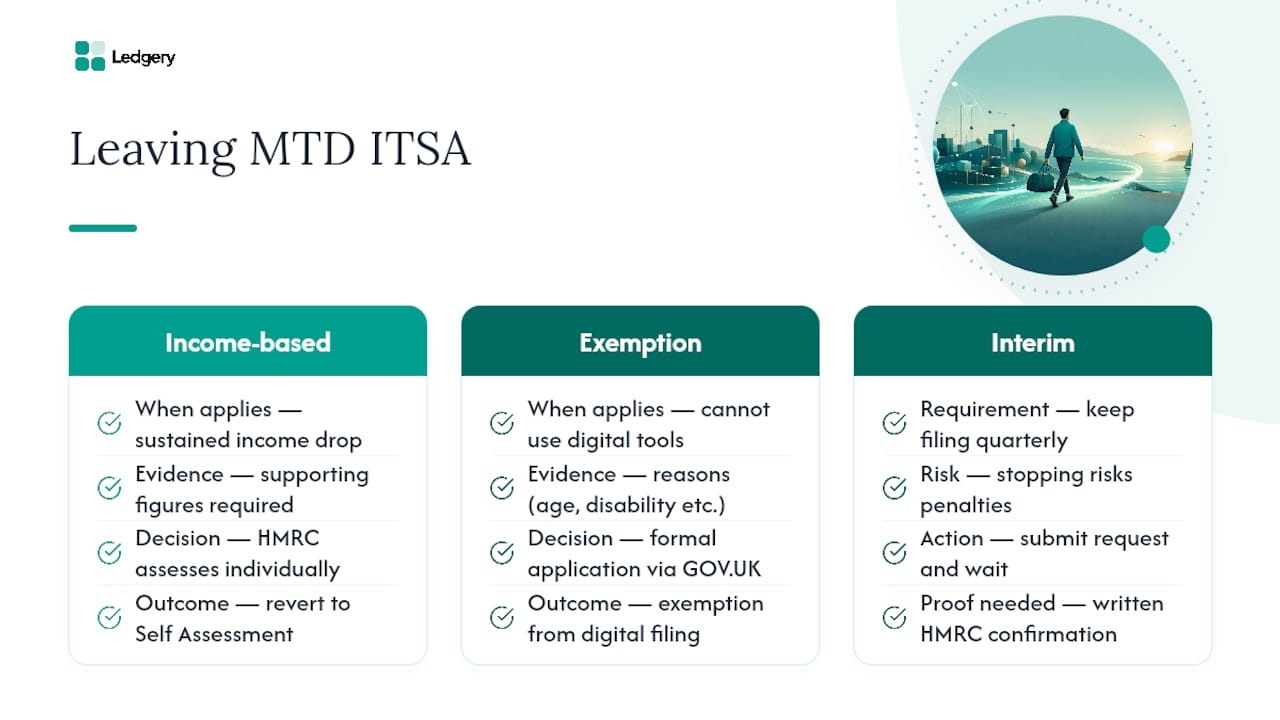
If your qualifying income falls below the relevant threshold and looks likely to stay there, you can apply to leave MTD ITSA and revert to the standard Self Assessment return. This typically applies where a business has genuinely wound down, a rental property has been sold, or income has dropped for reasons unlikely to reverse quickly, rather than one unusually slow year. HMRC assesses these cases individually rather than applying an automatic cutoff, so a request needs supporting figures showing the change is real and expected to continue.
There’s also a formal exemption route for people who cannot reasonably use digital tools, covering age, disability, location, or religious grounds. This is separate from a simple income drop and has its own application process through GOV.UK.
Until HMRC confirms your removal or exemption, you’re still expected to file quarterly updates. Stopping submissions unilaterally because you believe you should no longer qualify risks the same penalty exposure as any other missed deadline. Submit your request, keep filing as normal, and wait for written confirmation before changing your process.
Where do these deadlines usually go wrong?
Most missed deadlines aren’t the result of forgetting the date entirely. They come from small misjudgements that compound over a quarter.
A common one: a landlord assumes their rental income alone, at £22,000, keeps them well clear of the £50,000 threshold, not realising their separate self-employed consultancy work adds another £31,000. Combined, that’s £53,000, and they’re mandated a year earlier than expected. Another: a sole trader submits three quarters faithfully, then has a genuinely quiet fourth quarter with no invoices raised, and simply skips it, assuming nothing to report means nothing to file. That’s a missed deadline, not a non-event, since nil returns are still required.
A third pitfall involves the quarter election. Someone sets up calendar quarters because it matches their existing spreadsheet habits, then their accountant, working from standard tax-year quarters, submits based on the wrong period end. The fix is straightforward: agree the election with whoever handles your figures before the first submission, not after a mismatch appears.
The pattern across all three is the same. Deadlines rarely get missed through simple forgetfulness, they get missed because someone misjudged scope, assumed silence meant nothing to report, or left a configuration decision unresolved until it caused a discrepancy.
Why quarterly reporting rewards small, boring habits
The businesses that adapt easily to MTD ITSA aren’t necessarily the most organised on paper. They’re the ones who stopped treating bookkeeping as a once-a-year event long before the mandate forced the issue.
Weekly capture beats quarterly panic for one simple reason: memory decays fast, and a receipt from eleven weeks ago rarely comes with a clear story attached. Four quarterly deadlines a year, rather than one annual scramble, actually works in your favour if you build the habit early. It forces small, regular discipline instead of a single high-stakes reconciliation every January.
The soft landing for 2026/27 is generous, but it’s also temporary cover for exactly the kind of disorganisation that gets expensive from 2027/28 onward. Build the weekly habit now, while the penalty points don’t bite, and the transition to real enforcement will feel like nothing changed at all. For more on preparing specific income types, see Ledgery’s guide for sole traders and landlords.
— Jason
Ledgery helps you hit every MTD ITSA deadline without the admin backlog
Some software turns the weekly habit this article recommends into something more efficient by categorising receipts and rolling them into quarterly totals, ready for submission ahead of each 7th-of-the-month deadline.

A free trial period may let you test the whole workflow, sign up, scan some receipts, and see your first quarterly summary build itself before committing. Deadline alerts can help ensure you don’t rely on memory for key dates. Some software solutions are designed specifically for sole traders and landlords, with categories and prompts aligned to HMRC requirements for those income types. If you’d rather sort payment records than chase paper invoices, this guide to invoice payments pairs well with keeping your quarterly figures accurate.
Check your 2024/25 figures against the thresholds above, then start your free quarter with Ledgery and have your first quarterly update ready long before the deadline arrives.
Sources
Recommended
Self-employment and property income in one subscription, first quarter free. Join the early access list and we’ll email you once, when it opens.
Join early access