The property income allowance: a clear guide for UK landlords

The property income allowance gives individuals up to £1,000 of property income tax-free each tax year. HMRC introduced this relief from 6 April 2017, and for many small-scale landlords it removes the need to file a tax return at all. The immediate decision is straightforward:
- Gross property income ≤ £1,000: full relief applies. You normally do not need to tell HMRC anything, unless you are already required to file a Self Assessment return for other reasons.
- Gross property income between £1,000 and £2,500: contact HMRC directly. Do not assume you can ignore it.
- Gross property income above £2,500: register for Self Assessment and declare the income on your tax return.
The GOV.UK renting-out-a-property guidance confirms that the first £1,000 of rental income is tax-free under this allowance. The Low Incomes Tax Reform Group (LITRG) adds a practical note: always calculate both the allowance route and actual expenses before deciding, because the better option depends on your specific costs.
Key takeaways
The property income allowance gives UK individuals up to £1,000 of property income tax-free each year, but the right action depends on your gross income level, your actual expenses, and whether any connected-party income applies.
| Point | Details |
|---|---|
| £1,000 threshold | Gross property income at or below £1,000 means full relief and no reporting obligation in most cases. |
| Three reporting routes | Income ≤ £1,000: no action. £1,000–£2,500: contact HMRC. Above £2,500: register for Self Assessment. |
| Connected-party exclusion | Any income from a connected employer or close company removes the allowance for that entire tax year. |
| Allowance vs expenses | Calculate both options each year; the allowance is not always better, especially when repair costs are high. |
| Keep records regardless | Retain tenancy agreements, receipts, and bank statements for at least five years and ten months if you file Self Assessment. |
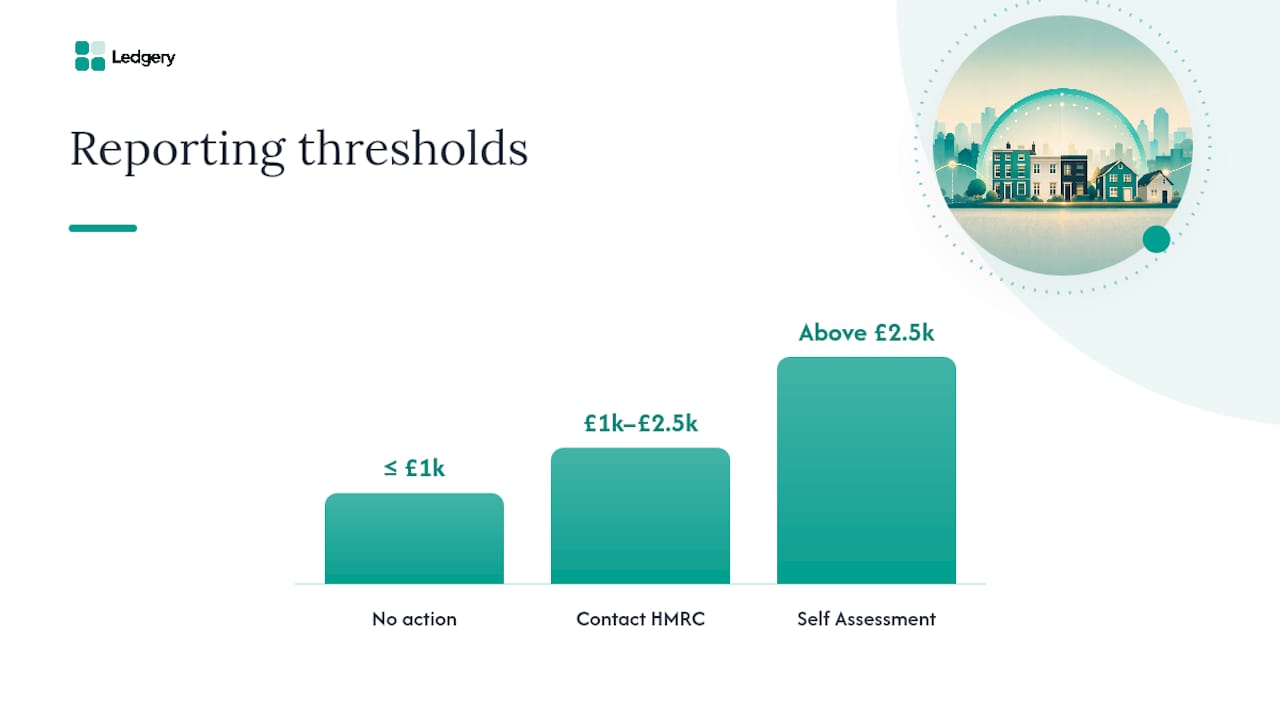
Table of Contents
- What counts as property income for the allowance?
- Who can use the allowance, and who cannot?
- When and how to tell HMRC about your rental income
- How to decide: use the £1,000 allowance or deduct actual expenses?
- What records does HMRC expect you to keep?
- Worked scenarios: full relief, partial relief, joint owners and multiple lets
- How accounting software can help you manage this decision
- Why good records matter more than most landlords realise
- Sources
What counts as property income for the allowance?
“Relevant property income” covers most receipts from land and property. Typical inclusions are rent from residential or commercial lettings, payments for services provided to tenants (such as cleaning or gardening), and income from leasing or licensing land. Overseas property income is included too. A single £1,000 allowance applies across all of an individual’s property businesses combined, including any overseas lets, as HMRC’s internal manual PIM4410 makes clear.
Furnished holiday lettings (FHL) receipts can also count towards the gross total, so landlords with FHL income should check the HMRC FHL helpsheet HS253 for how those figures interact.
One common point of confusion is Rent a Room relief. That is a separate scheme for letting furnished rooms in your own home, and it cannot be combined with the property income allowance for the same income. You choose one or the other.
Who can use the allowance, and who cannot?
Eligible:
- UK individuals with relevant property income, including joint owners. Each owner of a jointly held property can claim up to £1,000 against their own share of the gross receipts. The allowance is per person, not per property.
Excluded:
- Connected parties. If any relevant property income in a tax year comes from a connected employer, a connected firm, or a close company, the allowance is unavailable for that entire tax year. Even £1 from a connected source disqualifies it, as PIM4426 sets out explicitly.
- Partnerships. Income received through a partnership does not qualify.
- Companies. The allowance is for individuals only. Limited companies cannot use it.
- Finance-cost tax reducer (mortgage interest relief). If you claim the finance-cost tax reducer, you cannot also use the property income allowance for the same income. HMRC’s guidance on changes to residential landlord tax relief explains how the finance-cost mechanism works. Landlords with significant mortgage interest costs should compare both routes carefully before electing.
The connected-party trap catches people more often than expected. A landlord who rents a property to their own limited company, or to a business that employs them, loses the allowance for that year entirely.
When and how to tell HMRC about your rental income
The reporting route depends entirely on your gross property income before any deductions.
Gross income ≤ £1,000 (full relief) No action is normally required. The allowance covers the income in full. You do not need to register for Self Assessment solely because of this income. If you already file a return for other reasons, you still declare the income but claim full relief.
Gross income between £1,000 and £2,500 (contact HMRC) You must contact HMRC to discuss your position. HMRC may collect any tax owed through your PAYE tax code rather than requiring a full Self Assessment return, but you cannot simply ignore income in this band.
Gross income above £2,500 (Self Assessment) Register for Self Assessment and complete the SA105 property pages. The SA105 notes set out exactly which boxes to complete and how to claim the allowance or elect for partial relief. The deadline to register is 5 October following the end of the tax year in which you received the income. The online filing deadline is 31 January following the end of that tax year.
Electing out of full relief Using the allowance is optional. If your actual expenses exceed £1,000, you can choose to deduct those instead. The election applies per tax year, so you can make a different choice each year depending on your costs. Electing to use actual expenses rather than the allowance also means you can carry forward a loss if your expenses exceed your income, which the allowance route does not permit.
How to decide: use the £1,000 allowance or deduct actual expenses?
The choice comes down to a simple comparison. Work through these steps:
- Add up your gross property income for the tax year (rent received, service charges, any other relevant receipts).
- Add up your allowable expenses (letting agent fees, repairs, insurance, accountancy costs, and so on). Do not include mortgage capital repayments; those are not allowable.
- Compare the two routes:
- If your allowable expenses are less than £1,000, the allowance is almost always better. It gives you a larger deduction and removes the need to keep detailed expense records.
- If your allowable expenses exceed £1,000, deducting actual expenses will reduce your taxable profit further.
- If your expenses exceed your income (creating a loss), you must use actual expenses. The allowance cannot create a loss.
Worked example: allowance is better
Gross rental income: £3,200. Allowable expenses: £600 (insurance and minor repairs).
- Allowance route: £3,200 minus £1,000 = £2,200 taxable profit.
- Expenses route: £3,200 minus £600 = £2,600 taxable profit.
The allowance saves tax on an extra £400 of profit.
Worked example: expenses are better
Gross rental income: £3,200. Allowable expenses: £1,800 (letting agent fees, boiler service, insurance).
- Allowance route: £3,200 minus £1,000 = £2,200 taxable profit.
- Expenses route: £3,200 minus £1,800 = £1,400 taxable profit.
Deducting actual expenses saves tax on an extra £800 of profit.
LITRG recommends comparing both methods each year because the better option can shift as repair costs and income levels change. HMRC’s own guidance confirms the allowance is optional and that the election is made on a per-tax-year basis.
Pro Tip: Run both calculations before you file each year. A boiler replacement or a period of void can swing the decision significantly.
What records does HMRC expect you to keep?
Good records protect you whether you claim the allowance or deduct actual expenses. Keep the following:
- Tenancy agreements and any licence agreements with occupiers.
- Bank statements showing rent received (dates and amounts).
- Receipts and invoices for all repairs, maintenance, and improvements.
- Insurance certificates and premium receipts.
- Letting agent statements and fee invoices.
- Correspondence with tenants and agents that relates to income or expenditure.
- Any mortgage statements if you are considering the finance-cost tax reducer.
For Self Assessment purposes, HMRC expects records to be kept for at least 22 months after the end of the tax year for employed individuals, and at least five years and ten months after the end of the tax year for those filing Self Assessment returns. If HMRC opens an enquiry, you will need to produce these documents.
Keeping records of both your gross income and your actual expenses each year means you can make the allowance-versus-expenses decision with real numbers rather than estimates. That flexibility is worth preserving even in years when the allowance is clearly the better choice.
Worked scenarios: full relief, partial relief, joint owners and multiple lets
Scenario 1: full relief (no Self Assessment needed)
A landlord rents a parking space for £80 per month. Annual gross income: £960. Because this is below £1,000, full relief applies. No Self Assessment return is required solely for this income.
Scenario 2: partial relief (allowance beats expenses)
A landlord receives £1,800 in rent from a single let. Allowable expenses total £400.
- Allowance route: £1,800 minus £1,000 = £800 taxable profit. Simple, no expense receipts needed.
- Expenses route: £1,800 minus £400 = £1,400 taxable profit.
The allowance is clearly better here. The landlord registers for Self Assessment (income exceeds £2,500 threshold? No, it is between £1,000 and £2,500, so they contact HMRC first).
Scenario 3: joint owners
Two siblings jointly own a rental property producing £1,600 gross income per year. Each sibling’s share is £800. Because each person’s share is below £1,000, each can claim full relief individually. Neither needs to file a Self Assessment return solely for this property income.
| Situation | Per-person gross income | Allowance available? | Reporting route |
|---|---|---|---|
| Sole owner, under £1,000 gross | under £1,000 | Full relief | No action needed |
| Joint owners, £1,600 total | £800 each | Full relief per person | No action needed |
| Sole owner, £1,800 gross | £1,800 | Partial relief available | Contact HMRC |
| Sole owner, above £2,500 gross | above £2,500 | Partial relief available | Self Assessment |
| Any owner, income from connected employer | Any amount | Not available | Self Assessment |
A common misconception is that the £1,000 allowance applies per property. It does not. It applies per individual, across all their property income combined.
How accounting software can help you manage this decision
The allowance-versus-expenses decision is straightforward in principle but easy to get wrong in practice, particularly when income and costs vary across the year. Software that captures receipts as they occur, tags them to the correct property, and produces a clear summary of gross income and allowable expenses removes most of the friction.

Features worth looking for in any property income tool include: automatic receipt capture (photographing invoices and agent statements rather than filing paper), the ability to categorise income and expenses by property, clear reports showing gross receipts and total allowable costs side by side, and deadline reminders for Self Assessment registration and filing.
Ledgery is built for exactly this kind of use case. It uses AI-powered receipt scanning to capture expenses as they happen, organises income and outgoings into clear quarterly summaries, and sends deadline alerts so nothing is missed. For landlords who want to compare the allowance and expenses routes quickly at year end, having all the figures already organised in one place makes the calculation straightforward. Ledgery also supports the quarterly reporting requirements of Making Tax Digital (MTD), which will affect many landlords in the coming years.
FreeAgent also offers plain-English guidance on the property income allowance for landlords who want a software-based explanation of how the relief works.
Try Ledgery free for your first quarter and see how much simpler the allowance-versus-expenses decision becomes when your records are already organised.
Why good records matter more than most landlords realise
The property income allowance is genuinely useful for small-scale landlords, but it is also one of the areas where simple errors are most common. Landlords sometimes treat the £1,000 as an additional deduction on top of their actual expenses, when in reality it replaces them. Others miss the connected-party exclusion entirely and claim the allowance in a year when income from a related employer or company makes it unavailable.
The fix for both errors is the same: keep clear, complete records from the start of each tax year, and run the numbers before filing rather than after. A landlord who knows their gross income and total expenses by April has a genuine choice. One who has to reconstruct figures from memory in January does not.
Sources
The following sources were used to build this guide. Check them directly for HMRC’s exact wording or for situations not covered here.
- Gov
- Property income | Low Incomes Tax Reform Group
- Use these notes to help you fill in the (SA105) - HMRC (PDF)
HMRC guidance changes periodically. Always check the current version of any GOV.UK page before filing, and consider speaking to a tax adviser if your situation involves connected parties, overseas property, or significant finance costs.
This article provides general information only and is not a substitute for professional tax advice. Confirm current rules with HMRC or a qualified adviser before making any filing decisions.
Recommended
Self-employment and property income in one subscription, first quarter free. Join the early access list and we’ll email you once, when it opens.
Join early access