UK quarterly tax dates: MTD deadlines and payment dates

Quarterly Making Tax Digital updates are due on the 7th of the month after each quarter ends. For the first mandatory quarter under the new rules, that means the deadline falls on 7 August 2026, covering income and expenses from 6 April to 5 July 2026. These quarterly updates are separate from the payments you actually owe HMRC.
The two dates that matter most for your bank balance are still 31 January and 31 July, which govern your Self Assessment balancing payment and payments on account. HMRC regulates both systems, and MTD-compatible software such as Ledgery can automate the quarterly submission side while you focus on the payment side.
- Quarterly update deadline: 7th of the month after each quarter ends
- Balancing payment and first payment on account: 31 January
- Second payment on account: 31 July
- Regulator: HMRC, via the Self Assessment and Making Tax Digital frameworks
Key Takeaways
Meeting quarterly tax dates UK obligations comes down to tracking two separate calendars: MTD update deadlines on the 7th of the month, and Self Assessment payment dates in January and July.
| Point | Details |
|---|---|
| Quarterly update deadline | Submit MTD updates by the 7th of the month after each quarter ends. |
| First mandatory deadline | Q1 2026/27 update is due by 7 August 2026 for income above £50,000. |
| Payment dates unchanged | Balancing payment and first payment on account fall due 31 January; second instalment on 31 July. |
| Updates aren’t payments | Quarterly submissions summarise income and expenses; they don’t settle your tax bill. |
| Automate capture early | Tools like Ledgery scan receipts and sort them into HMRC-ready quarterly updates. |
Table of Contents
- Who has to submit quarterly tax dates UK updates now?
- Your quarterly tax filing dates calendar for 2026/27
- When do payments on account and balancing payments fall due?
- How to meet quarterly deadlines without last-minute panic
- How Ledgery handles quarterly HMRC updates for you
- Can you make voluntary quarterly payments if MTD doesn’t apply yet?
- Do VAT deadlines clash with your quarterly tax dates?
- What the deadlines actually demand from you
- Sources
Who has to submit quarterly tax dates UK updates now?
Making Tax Digital for Income Tax becomes mandatory from 6 April 2026 for sole traders and landlords with combined gross income above the current threshold set by HMRC. That threshold looks at your total self-employment and property income together, not each source separately, so a landlord earning £35,000 in rent plus £20,000 from freelance work would qualify even though neither figure alone crosses the line.
The scope widens over the following two years. Anyone earning above a specified lower threshold joins from April 2027, and the plan is to bring in everyone above a further reduced threshold from April 2028. If you sit below £50,000 today but expect growth, it’s worth getting your digital records sorted before the threshold catches you.
- Income above £50,000: mandatory from April 2026
- Income above £30,000: mandatory from April 2027
- Income above £20,000: mandatory from April 2028 (planned)
- Combined income means self-employment plus property income added together
Most people will follow standard tax-year quarters, but some software allows calendar-quarter alignment instead. Both options exist, but tax-year quarters are the default and the simplest to track alongside your Self Assessment year.
Your quarterly tax filing dates calendar for 2026/27
Once you know your quarter ends, the due dates follow a predictable pattern: add one month and seven days. For the 2026/27 tax year, the standard schedule runs like this.
| Quarter | Period Covered | Update Due By |
|---|---|---|
| Q1 | 6 April – 5 July 2026 | 7 August 2026 |
| Q2 | 6 July – 5 October 2026 | 7 November 2026 |
| Q3 | 6 October – 5 January 2027 | 7 February 2027 |
| Q4 | 6 January – 5 April 2027 | 7 May 2027 |
The 7 August 2026 deadline marks the first time this cycle becomes compulsory for anyone earning over £50,000, so it’s the one date worth pinning above your desk now.
If your software uses calendar quarters instead of tax-year quarters, your period ends will shift to the last day of March, June, September and December, with the same seven-day filing window afterwards. Check which setting your software defaults to before your first submission, since mixing the two can throw off your record-keeping.
When do payments on account and balancing payments fall due?

Quarterly updates are summaries, not payment requests. HMRC uses them to build a running picture of your income, but your actual tax bill still follows the Self Assessment calendar, which quarterly updates do not replace.
Two dates carry the real financial weight. On 31 January, you pay any balancing payment owed for the previous tax year, plus your first payment on account for the current year. On 31 July, your second payment on account falls due. Each payment on account is usually calculated as 50% of your previous year’s total tax bill, so if you owed £6,000 last year, expect two instalments of £3,000 each.
- 31 January: balancing payment plus first payment on account
- 31 July: second payment on account
- Payments on account: typically 50% of the prior year’s liability, split across two dates
- Late payment or late filing can trigger penalties and interest charges from HMRC
That January date is where most cashflow problems start. If your income grew significantly the previous year, you could be settling last year’s tax and prepaying half of next year’s estimate on the same day.
Pro Tip: Set aside roughly a third of every payment you receive into a separate account as it lands, rather than waiting until January to work out what you owe.
Payments on account exist to spread your liability across the year rather than lumping it all into one January bill, but they only work smoothly if you’ve planned for both dates rather than treating 31 July as an afterthought.
How to meet quarterly deadlines without last-minute panic
Getting quarterly updates in on time comes down to habits, not luck. Here’s a routine that keeps you ahead of every deadline.
- Choose MTD-compatible software early. Confirm it can export directly to HMRC before your first quarter closes, not the week the deadline arrives.
- Capture receipts and invoices as they happen. Record the date, amount, VAT status where relevant, and the client or customer name for every transaction.
- Reconcile quarterly, not annually. Match bank transactions against your recorded income and expenses every three months so nothing slips through.
- Estimate your liability each quarter. Use a running total to work out roughly what you’ll owe, and set that amount aside rather than spending it.
- Build reminders into your calendar. Add the four quarterly dates and both payment dates the moment your tax year starts, and turn on any alerts your software offers.
- Loop in your accountant, if you use one. Share quarterly summaries as you go so nothing is a surprise at the annual return stage.
Pro Tip: Incomplete receipt capture is one of the most common mistakes people make with quarterly updates. Photograph receipts the moment you get them rather than storing paper copies for later.
How Ledgery handles quarterly HMRC updates for you
Ledgery is built around the exact problem this article describes: turning scattered receipts into a submission-ready quarterly update. Snap a photo of a receipt, and Ledgery organises it automatically into the correct quarter for your HMRC submission.
- Receipt scanning that sorts expenses into the right quarter automatically
- Deadline alerts so you never miss a 7th-of-the-month update
- Export functionality built for MTD-compatible submission
- Support for both sole trader and property income
The subscription starts with a free first quarter, which gives you a full cycle to test whether automated capture actually saves you time before paying anything. It’s aimed squarely at people earning above the £50,000 threshold who need to be compliant from April 2026 without spending hours on spreadsheets.
| Point | Details |
|---|---|
| Free trial period | Ledgery’s first quarter is free, letting you test the workflow before subscribing. |
| Core function | Automatic receipt scanning organises expenses into HMRC-ready quarterly updates. |
| Deadline support | Built-in alerts flag upcoming quarterly and payment deadlines. |
| Scope | Covers sole trader and property income, not limited companies or VAT. |
Can you make voluntary quarterly payments if MTD doesn’t apply yet?
If your income sits below £50,000, you’re not required to submit quarterly MTD updates yet, but nothing stops you from paying tax more often if that suits your cashflow better than one annual shock.
HMRC allows Self Assessment taxpayers to make payments on account voluntarily, or to pay in smaller instalments throughout the year using its Budget Payment Plan. You choose the amount and frequency, whether that’s weekly or monthly, and HMRC holds the money against your eventual bill. This works well if your income fluctuates and you’d rather chip away at your liability than face one large sum.
Many self-employed people below the MTD threshold also start using MTD-compatible software voluntarily, ahead of the mandatory rollout. Getting into the habit of quarterly reconciliation now, even without a submission requirement, makes the transition far less disruptive when the £30,000 threshold arrives in April 2027. It also gives you a clearer running total of what you owe, rather than discovering your liability in one go when your accountant finishes your return.
Voluntary quarterly payments don’t change your official deadlines. Your balancing payment and any payment on account still fall due on 31 January and 31 July regardless of how often you’ve been setting money aside. The benefit is purely about smoothing your own cashflow rather than meeting a new legal obligation.
Do VAT deadlines clash with your quarterly tax dates?
VAT operates on its own separate quarterly cycle, and it’s easy to confuse the two systems if you’re registered for both. Ledgery’s current scope covers income tax for sole traders and property income, not VAT, so if you’re VAT-registered, you’ll need separate software or a bookkeeper for that side.
VAT quarters are set individually when you register, based on your business’s own stagger group, which HMRC assigns rather than aligning to the standard tax-year quarters used for MTD Income Tax. This means your VAT return deadline and your MTD Income Tax quarterly update deadline can easily fall in different weeks of the same month, or even different months entirely.
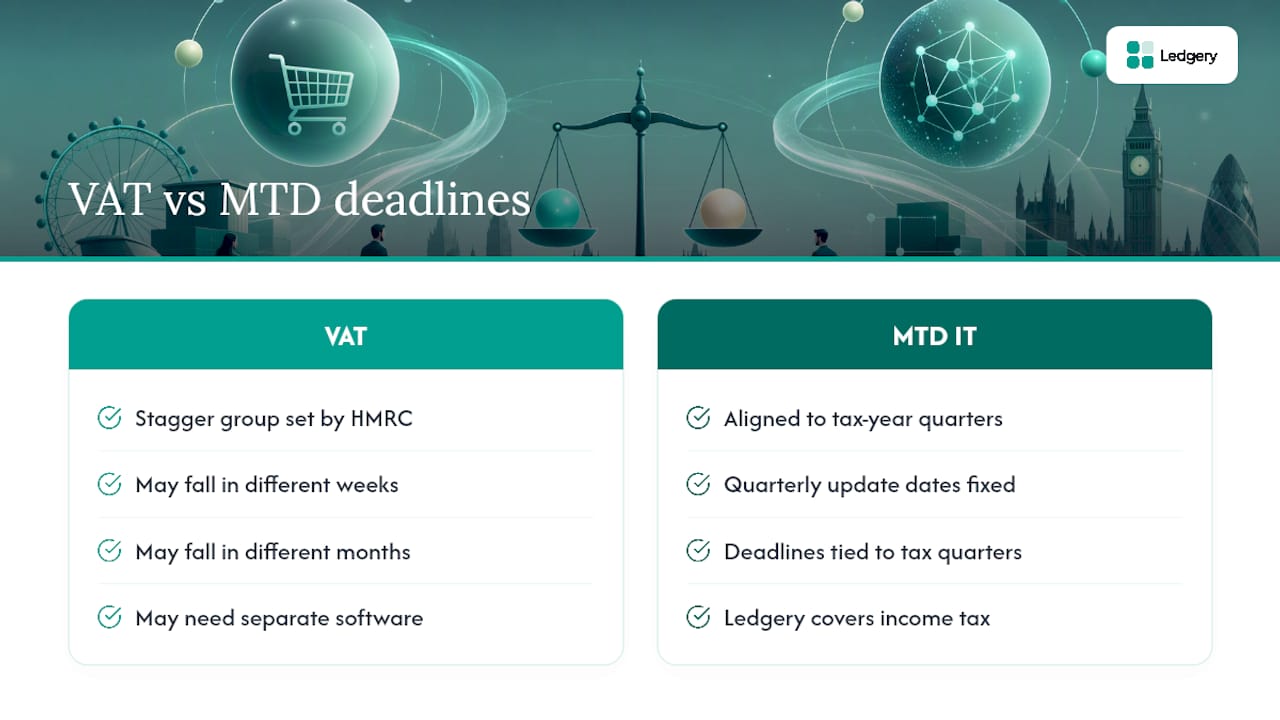
If you run a VAT-registered business alongside self-employment or rental income above £50,000, you’re effectively managing two independent quarterly systems with different rules, different software requirements in some cases, and different penalty regimes. The practical fix is keeping both deadline sets in the same calendar, colour-coded if it helps, so a VAT return due date doesn’t sneak up on you while you’re focused on an Income Tax update. Neither system currently talks to the other, so double-checking both each quarter is on you.
What the deadlines actually demand from you
The conventional advice on MTD treats it as a software problem: pick a tool, connect it to HMRC, done. That misses the real shift. The burden isn’t the submission itself, which takes minutes once your records are current. It’s the discipline of keeping records current every single week, not scrambling every three months.
Most people who struggle with quarterly updates aren’t failing at tax. They’re failing at filing receipts the day they get them. That’s a habit problem, not a compliance problem, and no amount of software fixes a habit you haven’t built.
If you take one thing from this, prioritise the 31 January cashflow squeeze over the quarterly updates themselves. A late quarterly submission is a fixable inconvenience. A missed balancing payment plus payment on account, discovered too late to plan for, is a genuine financial hit. Build your reserve before you worry about the paperwork.
— Jason
This article is general information, not a substitute for advice from a qualified financial advisor. Consult a qualified financial professional about your own circumstances before acting on anything here.
Sources
Recommended
Self-employment and property income in one subscription, first quarter free. Join the early access list and we’ll email you once, when it opens.
Join early access